
Support ASCF
If you liked this article, please share it with your friends and family. You can also help the American Security Council Foundation shape American policy.
Recent Articles

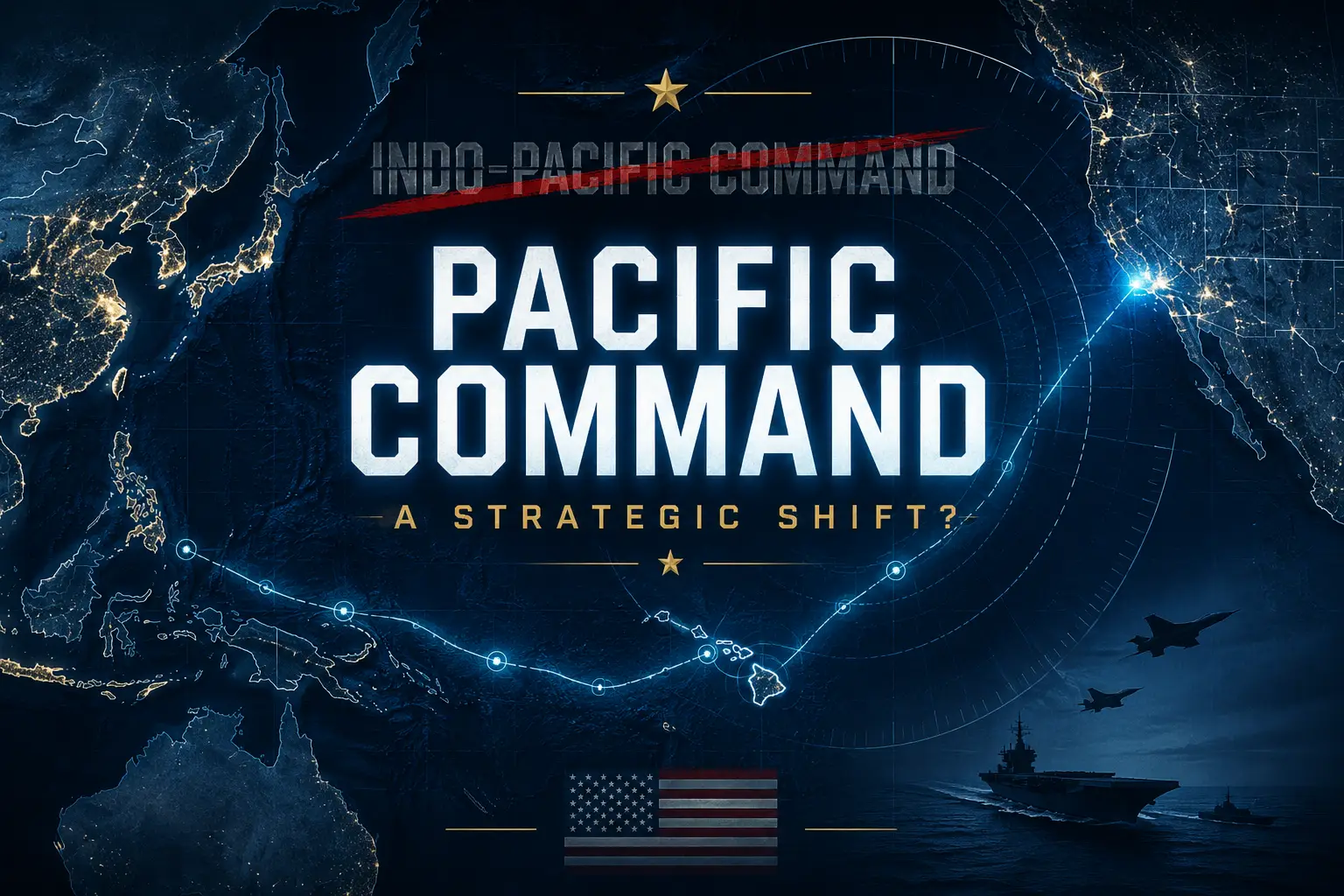
U.S. Pacific Command
Written by Tom Raquer, Lt. Col. (Ret.), USAF * Southeast Asia Foreign Area Officer
On June 16, 2026, the Department of War announced that the U.S. Indo-Pacific Command would revert to its former title: U.S. Pacific Command. The command still has a huge geographic responsibility, covering 36 nations, 14 time zones, and an area that accounts for about 60 percent of the world’s population.
Reverting to the name U.S. Pacific Command from Indo-Pacific Command is not merely an administrative change. This is an early strategic indicator that the United States may be narrowing its military aperture, re-focusing on the Pacific as the primary theater of long-term competition, and recalibrating the sweeping strategic assumptions associated with the term “Indo-Pacific.” The Chinese Communist Party (CCP )’s control of China is the main threat to the US. China is in the Pacific theater, not the Indian theater.
Command names signal strategic priorities to allies, adversaries, and the national security bureaucracy. The return to U.S. Pacific Command indicates a renewed focus on maritime geography, force posture, logistics, and deterrence across the Pacific. The change does not exclude the Indian Ocean from the command’s responsibilities, but it signals a more disciplined hierarchy of strategic priorities.
Southeast Asian governments should see the shift as an early warning, not as proof of an imminent change in American policy. The bigger question is whether American strategy is beginning to more distinctly separate a military theater from the American nation’s identity.
On the face of it, the change would seem to be mostly symbolic. It is not. Military organizations use names to establish priorities, organize bureaucracies, communicate strategic intent, and shape how political leaders think about the theaters in which forces operate.
In 2018, the U.S. Department of Defense renamed the U.S. Pacific Command as the U.S. Indo-Pacific Command to emphasize the growing strategic importance of India and the Indian Ocean. Defense officials said the change reflected the region’s increasing economic and security ties. (U.S. Department of War) The 2026 restoration, therefore, deserves attention.
This does not mean Washington is backing away from India, shunning the Indian Ocean, or transforming the command’s area of responsibility overnight. A new sign outside its headquarters will not alter the command’s mission and partnerships.
But language matters strategically.
Policymakers have used the term “Indo-Pacific” to encompass a vast area stretching from the western Indian Ocean to the Pacific coast of the Americas as a single strategic system. This formulation was true to the actual interconnections of trade routes, alliances, military access, energy flows, and competition with China.
It also risked being overextended strategically. Every country has limits to its military resources, political attention, industrial capacity, and public consent. The Indo-Pacific is not one theater, continuous and equally important. Treating it as such can obscure the need to prioritize within it.
The return of Pacific Command signals a more focused strategic outlook. The Pacific maritime theater, the First Island Chain, allied access, forward logistics, naval and air power, and deterrence of major-power conflict may be moving closer to the center of American military planning.
That is an inference, not a policy change. Thus, Southeast Asian governments should not overreact to the name change. Existing alliances, exercises, access arrangements, and security cooperation programs are likely to persist in the near term.
The longer-term implications might be more important. If shifts follow the restoration in force posture, funding, logistics, basing, munitions production, and alliance expectations, that will be evidence of a broader American strategic reorientation.
That could create opportunities and risks in Southeast Asia. Maritime security cooperation may be more important. Access to ports, airfields, repair facilities, and supply networks may become of greater strategic importance. Meanwhile, regional states may face increased pressure to clarify the extent of support they are prepared to provide in a future contingency.
The greater significance is not in military geography. The United States is not an Indo-Pacific nation-state. It is a constitutional republic with Pacific interests. But a military theater should be able to help organize forces; it should not redefine national identity or make every regional contingency an automatic American obligation.
The resurrection of U.S. Pacific Command may be an early sign that Washington is beginning to regain that distinction. Just the name is not a strategy. But it might tell us where the next American strategy is starting to look.