

Part 1 of 4 in Union Brief’s Series
Written by: Nathaniel Rendell
A Brief Foreword to Soft Crusades
Buddhism, Hinduism, Judaism, Islam, Christianity.
Panchamrit, matzah, dates, bread and wine.
Vesak, Diwali, Passover, Ramadan, Easter.
Brahman, Nirvana, The Ten Commandments, The Five Pillars, The Sabbath.
Religion has declined significantly in the United States since the late 20th century, but it is how most societies and nations have organized historically, not only in their laws and structure but also their culture. How explicitly a nation connects its predominant religion to its politics varies, though. Iran, for example, is far closer to a theocracy than the United States. The theocratic or secular character of nations shapes their culture, and vice versa.

Figure 1: The Religion to Politics Pipeline (Union Brief)
This pipeline highlights how religious doctrines inform morality, which in turn shapes culture and politics. Non-religious individuals derive morality from other sources, but the chain still operates. Cultural relativism, the idea that all cultures are equally valid, creates friction here. Applied consistently, it demands moral and political relativism, permitting practices like female genital mutilation or historical segregation without external judgment. Most self-described relativists apply it selectively within an implicit moral framework.
In this series, I examine how large-scale immigration from culturally and religiously distant societies introduces negative externalities when unchecked. Because religion is the primary driver of many such cultural differences, it takes center stage in the analysis of “soft crusades”—incremental demographic and institutional shifts in Western countries.
Religion & Immigration
Immigration remains one of the most divisive issues in Western countries. Many argue that migrants need only subscribe to “Americanism” or equivalent national values. This view understates deeper dynamics. Traditional American culture draws heavily from Christian—particularly Protestant—thought, as seen in many founders’ writings, even as the Constitution established separation of church and state. The 1797 Treaty of Tripoli states the U.S. government “is not, in any sense, founded on the Christian religion.” Western nations operate with secular constitutional frameworks, even as their cultural norms reflect historical Christian influences. They aren’t purely secular economic zones; their norms and holidays (e.g., Christmas) reflect historical religious foundations.
If we reduce all Western countries to secular economic zones, we ignore the fact that other countries were, and are currently being, shaped by religion across the world. Subscribing to an ambiguous description of Western values still leaves room for societal transformation by way of customs, culture, etc. If those are somewhat downstream of religion in most circumstances and upstream of politics, religion remains the root cause for most societal shifts.
Embracing secularism as a nation would require all immigrants to be non-religious in order to preserve that order. Religious people would likely shape society in a way in which the secular natives wouldn’t support unless they agree on all policy prescriptions without the belief in a higher power. This is the same principle applied to a religious nation when a different religion is immigrating: societal change is inevitable (to varying degrees) when religious conflict is introduced. Those who aren’t concerned with religion, or lack thereof, when discussing immigration, are welcoming, or ignoring at best, societal transformation. As I’ll cover, this transformation does in fact extend to actual law—it doesn’t stop at diet or holidays.
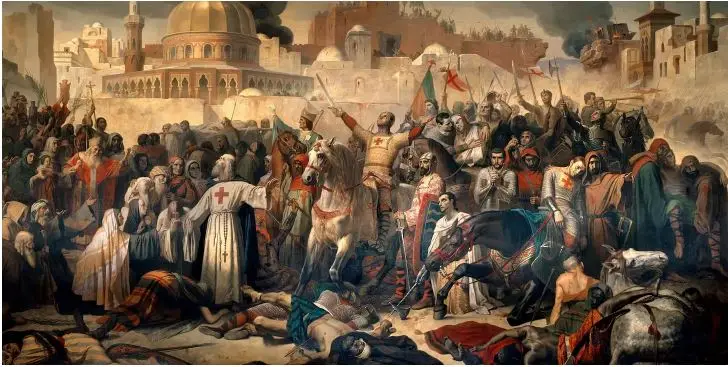
“Siege of Jerusalem” Leemage/Corbis via Getty Images
The “Original” Crusades
History & Timeline
When I refer to the “original” crusades, I’m referring to the ones commonly referred to as THE Crusades. The Crusades were religious wars fought between Muslims and Christians for about 200 years from the 11th-13th century, launched from Europe into the Levant. Before I explore the justification, I want to provide a brief timeline from the late 1090s to the late 1290s.
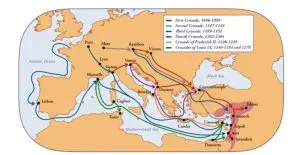
Figure 2: Map of the Crusades (Strayer, 2026)
First Crusade (1095–1099): The First Crusade was called by Pope Urban II at the Council of Clermont in 1095, responding to Byzantine Emperor Alexios I’s appeal for aid against the Seljuks. Historians note that this was largely motivated by religious zeal, promises of sin remission, land, and wealth. Crusader armies captured Jerusalem in 1099, establishing the Kingdom of Jerusalem and other Crusader states (Edessa, Antioch, Tripoli). The conquest involved the massacre of Muslim, Jewish, and some Christian inhabitants as was standard in medieval sieges during this time period.
Second Crusade (1147–1149): The Second Crusade was triggered by the fall of Edessa to Zengi in 1144. It was led by Louis VII of France and Conrad III of Germany and failed to achieve major gains.
Third Crusade (1189–1192): The third was sparked by Saladin’s recapture of Jerusalem in 1187 after the Battle of Hattin. It was led by Richard I of England, Philip II of France, and Frederick I of Germany. They recaptured coastal cities but not Jerusalem, ending in a truce allowing Christian pilgrimage.
Fourth Crusade (1202–1204): In the Fourth Crusade, Venetian interests diverted the Crusaders to sacking Christian Constantinople instead of targeting Muslims. It weakened Byzantium long-term and deepened the East-West Christian schism.
Later Crusades (13th-15th century): Frederick II negotiated temporary control of Jerusalem in the Sixth Crusade (1228–1229). Declining European support and rising Mamluk power led to the fall of Acre, the last major Crusader stronghold, in 1291. Smaller expeditions continued into the 14th–15th centuries (e.g., against the Ottoman Turks), but the classic Levantine Crusades ended in 1291.
Scale & Impact: Roughly 100,000–200,000 European participants across major campaigns over two centuries. There was extremely high mortality from disease, battle, and overall logistics. The Crusades established short-lived states (1099–1291) that blended feudal European and local practices. They facilitated some cultural/technological exchange (e.g., via trade, Arabic learning) but primarily military-religious conflicts. Both sides committed atrocities as warfare norms of the era included siege massacres and enslavement.
Were The Crusades Justified?
Following the death of Muhammad in 632, Muslim armies rapidly conquered formerly Christian territories including the Levant, North Africa, and parts of Spain and Anatolia. Jerusalem fell in 638. By the 11th century, Seljuk Turks threatened the remaining Byzantine Empire and restricted Christian pilgrimage access to holy sites, with reports of persecution including violence and harassment reaching Europe. Pope Urban II’s call at Clermont (1095) framed the First Crusade as aid to Eastern Christians and recovery of holy sites. Christians viewed the Crusades as defensive restoration under just war principles, countering centuries of expansion.
Under Islamic rule, Christians and Jews (as “People of the Book”) received dhimmi status. This granted protection of life, property, and limited religious practice in exchange for:
- Payment of jizya: a poll tax on adult non-Muslim males, exempting them from military service and zakat. The rates varied, but the poor, women, children, and elderly were often exempt. In theory, failure to protect dhimmis required refunding the tax.
- Restrictions: Dhimmis faced social and legal disabilities in the forms of second-class status, prohibitions on building/repairing churches without permission in many periods, distinctive clothing, and public subordination. Enforcement fluctuated by ruler and era. Some periods were tolerant (e.g., early Umayyad), but others involved humiliation or higher burdens. The jizya symbolized submission and funded the state.
These restrictions created a formal system of religious hierarchy with second-class legal status for dhimmis. Jizya functioned as a poll tax symbolizing submission and often encouraged conversion over time. As said above, enforcement varied significantly by ruler and era, but this system represents an early institutional form of religious differentiation that some draw parallels to in modern debates.
The Crusades are seen by many as a response gone too far. Sacking Christian Constantinople in 1204 undermined the “defensive” narrative and the Crusades introduced new escalations. Neither side, however, operated in good faith under self-determination and ethics of religious freedom.
What are “Soft Crusades”?
When I refer to “soft crusades,” I mean incremental, non-military shifts toward Islamic norms through demographic change, cultural accommodation, and institutional pressures—without traditional warfare. As I established in my No Rules Series, war is no longer purely kinetic. A holy war can be waged without a single shot being fired. If the United States established a tax on non-Christians, even with Christians being required the same tax, to support the church, it would be an attack on religious freedom. And jizya taxes still exist explicitly today in extremist areas controlled by JNIM, ISIS, and the Taliban.
A crusade is explicit, but a soft crusade has plausible deniability. No modern nation-state imposes jizya as official policy. Muslim scholars from over 100 countries signed the Marrakesh Declaration in 2016, calling for protection of religious minorities. Today’s international norms largely reject explicit religious taxes like jizya, yet unchecked immigration from culturally distant societies can still enable gradual institutional and demographic shifts.
The relevance today lies in cultural and political implications: differential fertility, integration gaps, and value divergences can gradually reshape host societies when immigration is unchecked. This includes pressures on women’s rights, free speech, and secular norms in high-Muslim-density areas—parallel to how religion historically drives societal change.
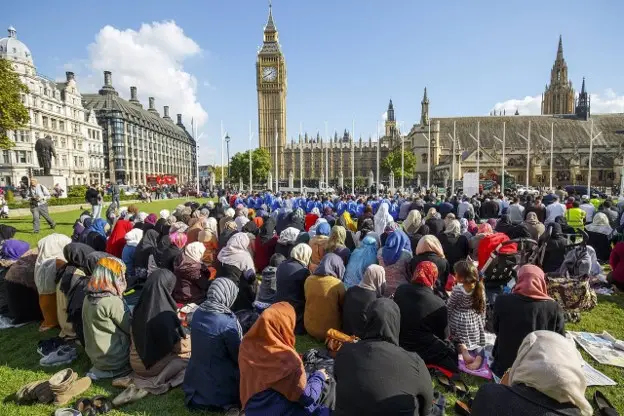
Soft crusades operate through incremental accommodations and parallel structures. In the United Kingdom, estimates place the number of Sharia councils at around 85. These bodies adjudicate family disputes, marriages, and divorces according to Islamic principles. While they lack formal legal authority under British law, they exert significant influence within Muslim communities.
Similar patterns appear elsewhere: demands for gender-segregated spaces in public facilities (swimming pools, universities), halal-only options in schools, and self-censorship on religious topics in education and media following incidents like the Batley Grammar School protests in 2021 or the murder of Samuel Paty in France in 2020.
The engine of these shifts is primarily demographic. Even under Pew Research’s “zero migration” scenario, Europe’s Muslim population share is projected to rise from ~5% to 7.4% by 2050 due to higher fertility rates and younger age structure. In medium- and high-migration scenarios, that share reaches 11–14%. In specific countries and cities, concentrations are already far higher, creating conditions for parallel societies where informal norms diverge from national secular standards.
Europe is ground-zero for soft crusades, but the Atlantic Ocean is no longer uncrossable. Learning from Europe’s experience is vital to avoid similar tensions in the United States.
Nathaniel Rendell is an American finance professional with about six years of experience in the consulting industry. He graduated from the University of Florida with a Bachelor of Science in Business Management and the University of Central Florida with a Master of Business Administration. He is the founder of and main writer for Union Brief, a publication providing conservative perspectives backed by research and data.
Be sure to follow him on Substack https://unionbrief.substack.com/