




Written by Nathaniel Rendell, American finance professional and main writer for Union Brief https://unionbrief.substack.com/
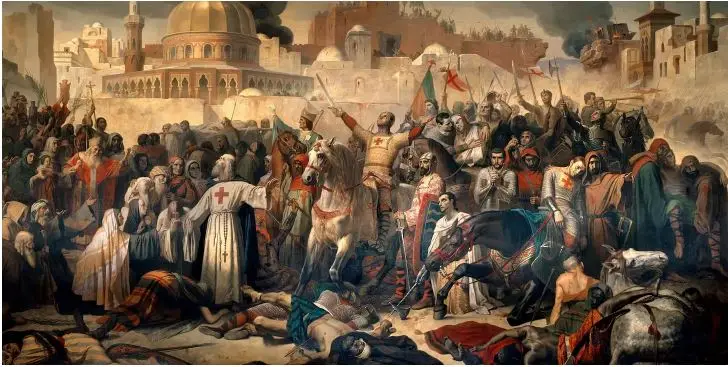
In Soft Crusades I, we established the thesis that religion, or lack thereof, drives politics, whether directly or indirectly. Morality and culture shape the policies, but religious beliefs shape all three upstream. Defining “soft crusades” as that gradual reshaping toward a religion foreign to the home nation shows the parallels between the original Crusades and what many countries in the West are experiencing today.
In the Crusades, a nation state would be violently taken over in the name of religion. In a soft crusade, a country is taken over by way of a gradual change in the three domains upstream of politics: religion, morality, and culture. When a Western nation is welcoming of immigrants no matter how much those three domains align, it are indirectly, or sometimes directly, inviting its own takeover.
This isn’t to say that all “takeovers” are created equal—an individual that comes to the United States and assimilates to Americanism wholesale is not the same as a refugee who flees their home country but brings their same religion, morality, or culture, refusing to adapt to American norms. But all norms are also not created equal—a difference in diet and holidays is much more understandable than a difference in how someone treats women, for example.
The problem lies in those areas where the differences extend beyond those diet and holidays. Those who say there isn’t a problem of differences that extend beyond diet and holidays view religion superficially and either don’t understand how religion shapes the other domains or choose to ignore that shaping. Many religious and nonreligious people already subscribe to their home nation’s morality/cultural/political norms, but that’s not to say that those norms are disconnected from religion. People who live in a country that’s been shaped by its initial religion already often forget that initial shaping occurred.
This leaves us with a couple of questions: 1) what does a country begin to look like when a foreign population comes in if they’ve been shaped by religion explicitly or implicitly and 2) how does that occur? In Soft Crusades II, we’ll focus on the “how” and in Soft Crusades III, we’ll focus on the result.
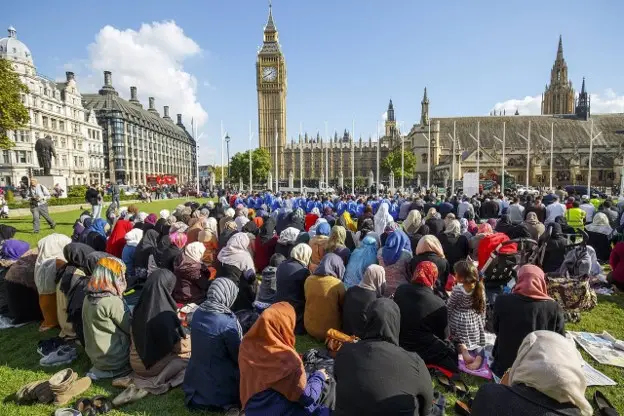
Muslims taking part at the first ever congregational Friday prayer in Parliament Square in London, England (Tolga Akmen/Anadolu Agency/Getty Images 2015)
Changing Demographics in Europe
In this section, I’ll explore how the demographics in Europe are changing and what that looks like compared to pre-immigration Europe. For purposes of the Soft Crusades Series, I’ll examine the United Kingdom, France, and Sweden, but many other Western nations such as Germany, Belgium, and Spain, are experiencing, or have experienced, many of the same changes. There is a huge religious component that most politicians either tiptoe around or don’t mention:
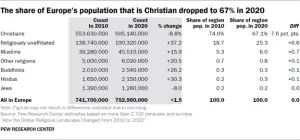
Figure 1: European Population by Religion 2010—2020 (Pew Research Center, 2025)
Not only do people fail to examine the religious component, the idea of “freedom of religion” has expanded into official policy in data collection. One of the most troubling trends in Europe is the complete lack of religious breakdown in many countries’ statistics. Whether it’s official policy or the idea that tracking religion trends leads to religious tension, it makes policymaking harder when data isn’t transparent. What you’ll see in this section is that most countries have to rely on surveys, roundabout ways of estimating via things like birth names, and qualitative data over quantitative (i.e. I see more Muslims in public, therefore the Muslim population has gone up).
England & Wales
Overall Population:
There were increases in the number of people who described themselves as “Muslim” (3.9 million, 6.5% in 2021, up from 2.7 million, 4.9% in 2011) (ONS, 2021)
- 32% of total UK population growth is Muslim.
- The medium or high projections are ~17% overall by 2050 (Pew Research Center, 2017).
Concentrations:
- Several London boroughs exceed 30% Muslim (ONS, 2021).
- Birmingham, Bradford, Oldham, and Leicester are >20–40% Muslim.
Fertility:
As of the 2021 Census, the Total Fertility Rate (TFR) for
- UK-born women was 1.54.
- Non-UK-born women was 2.03.
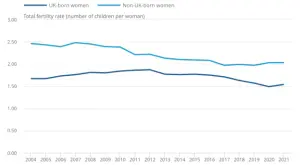
Figure 2: TFR for UK-born vs. Non-UK-born Women (ONS, 2021)
Migration:
- Post-Brexit, the UK shifted from EU to non-EU countries (primarily Pakistan, Bangladesh, Middle East, and Africa).
- Net migration remains primary population driver (98% of growth since 2020) (ONS, 2021)
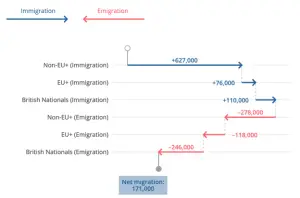
Figure 3: Long-term Immigration, Emigration and Net Migration of non-EU+, EU+ and British Nationals, Year Ending December 2025 (ONS, 2026)
Policy Drivers:
- Relatively open family reunification and student routes
- Student visas are now overwhelmingly non-EU+ and many students are transitioning to other visas post-graduation to stay in the country (ONS, 2026).
- Until 2020 reforms post-Brexit, the requirements for immigrating to the UK were relaxed. Major tightening occurred in 2025 via the Immigration White Paper, which raised income thresholds, restricted student dependents, and strengthened integration conditions.
Summary:
The UK Muslim population increases have been occurring because fertility rates are below replacement for natives and immigration is needed to support the economy. Brexit (official as of 2020) has driven the focus away from EU immigration to non-EU and the non-EU immigration has a large plurality of, if not majority, Muslim immigrants. With that, the Muslim population will likely increase even faster barring large-scale reform. If the Immigration White Paper proposals go into effect, immigration will likely be scaled back heavily and the trend may be slowed.
France
Overall Population:
While Catholicism remains the dominant religion (29% of the population declare themselves to be Catholic), Islam confirms its place as the second religion in France (10%). (INSEE, 2023)
- 10% would represent about 7 million people from the overall France population of 69.1 million.
- The medium or high projections are ~18% overall by 2050 (Pew Research Center, 2017).
Concentrations:
The Parisian suburbs are where most of the North African immigrants reside and therefore have the highest concentrations of Muslims:
The North-African population lives predominantly in the Seine-Saint-Denis department, Yvelines, and Val-de-Marne. Immigrants with Sub-Saharan origins mostly reside in the city center – in particular, the 18th, 19th, and 20th arrondissement and in three suburban cities: Bobigny in the Seine-Saint-Denis department, Vitry-sur-Seine in the Val de Marne department, and Cergy in the Val-d’Oise department. (Euro-Islam.info, 2025)

Foot Locker in Saint Denis with mannequins advertising sports hijab in 2022
Fertility:
- The national TFR fell to 1.56 in 2025, the lowest since WWI (INSEE, 2025).
- The natural population balance turned negative in 2025 for the first time since WWII, meaning growth is now almost entirely from net migration.
- Based on INSEE data of birth names, many reports suggest about 22.9% of newborns are given Muslim names compared to about 7% in 1997 (Fdesouche, 2024).
- That number is even higher in local areas such as Seine-Saint-Denis (58-60%).
- Religious affiliation is not officially surveyed for newborns, so first-name analysis is one of the few available proxies.
NOTE: Fdesouche is labeled a far-right news outlet similar to Breitbart in the US.
Migration:
Muslims now represent 10% of the population in metropolitan France, but are much more present among immigrants (44%) and the descendants of two immigrant parents (48%). 14% of the descendants of immigrants from mixed couples and 1% of the population without migratory ancestry claim a Muslim affiliation. (INSEE, 2025)
The proportion of Muslims in immigrant populations being higher is largely driven by the long history of post-colonial inflows from North Africa.
As of 2021, the foreign population in France amounted to 5.2 million people (7.7% of the population): 4.5 million are migrants who have not acquired French nationality, plus 0.8 million people born in France of foreign nationality. Most immigrants living in France that year came from either Africa (47.5%) or Europe (33.1%). Their main countries of origin were Algeria (12.7%), Morocco (12%), Portugal (8.6%), Tunisia (4.5%), Italy (4.1%), Turkey (3.6%), and Spain (3.5%). (Integral Human Development, 2021)
Policy Drivers:
- With immigration coming from many countries with higher proportions of Muslims than France, relaxed immigration in the post-colonial era has driven the Muslim population and percentage upward.
- Family reunification and asylum (i.e. Afghanistan)
- Laïcité, the French government policy of secularism, officially resists religious statistics and accommodations, leading to decreased data and the inability to make anti-policy arguments based on said data.
Summary:
France is in a similar position to the UK with regard to its Muslim population. Unchecked immigration from countries with majority-Muslim populations has led to a gradual increase of the Muslim proportion in France over the last few decades. If the birth rate data is accurate, the Muslim population will be approaching that ~23% with just its own current population. Similar immigration patterns to the past would accelerate that approach. Laïcité prevents the religious data collection which leads to policymaking in the dark without reporting from reputable outside sources.
Sweden
Overall Population:
- As of 2016, there were ~800,000–1 million Muslims (~8–10% of 10.6 million total population) in Sweden (Pew Research Center, 2017).
- The high-migration scenario puts this figure at 30.6% by 2050, which would be the highest in Western Europe.
Concentrations:
- Malmö, Gothenburg, and Stockholm suburbs now have areas >30–50% Muslim-origin.
- 60% of all Muslims in Sweden reside in those three cities (Euro-Islam.info, 2007).
Fertility:
The national TFR was around 1.4 as of 2024 (World Bank Group, 2025); Muslim-origin groups have a significantly higher TFR.
Migration:
- Sweden had extreme openness from 2014-2016 with the highest per-capita refugee intake in Europe (Migrationsverket, 2025).
- There was a partial tightening of border controls and asylum acceptance post-2015 as a result of lack of accommodation and a riot/crime wave.
- High non-Western inflows still persist:
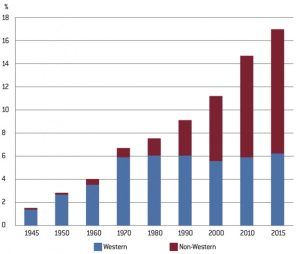
Figure 4: Immigrants’ proportion of the population, Western and non-Western origin (Fondapol, sourced from Statistics Sweden, 2026)
Policy Drivers:
- Like France, Sweden prevents the official collection of religious affiliation data by the government.
- Notably, Statistics Sweden also officially stopped tracking name statistics in 2024.
- As mentioned, there was a tightening of restrictions post-2015, but its borders were mostly open beforehand. Immigration restriction has become more dominant in the 2020s (CNBC, 2024).
Summary:
Just like the UK and France, the population rate is increasing although it may seem low as a percentage now. The native TFR being below replacement like the other European countries has driven Sweden to accept increased immigration for economic reasons. Sweden’s high levels of immigration, including the highest per-capita refugee intake in Europe from 2014–2016 and high non-Western inflows, are driving the Muslim population higher.
Europe’s demographic trajectory illustrates how sustained fertility differentials and selective migration patterns can produce rapid shifts in population composition over decades. These changes set the foundation for the cultural and institutional transformations we’ll examine in Soft Crusades III. We now know how it happened, but what are the effects?
Nathaniel Rendell is an American finance professional with about six years of experience in the consulting industry. He graduated from the University of Florida with a Bachelor of Science in Business Management and the University of Central Florida with a Master of Business Administration. He is the founder of and main writer for Union Brief, a publication providing conservative perspectives backed by research and data.
Be sure to follow him on Substack https://unionbrief.substack.com/