


Part 3 of 4 in Union Brief’s Series–
With Europe’s demographic changes in full view, we should take note of what policies led to the immigration waves. Whether or not to adopt similar policies in the US becomes a discussion of their results. Do the benefits of unfettered migration vastly outweigh the costs? Should we wall ourselves off completely and allow no immigration for fear of the worst case? Or should we be exclusive in our selection criteria so we ensure that we receive as many benefits as possible without the negative externalities?
In the United States, most would say they support the mixed option, but many don’t have the heart to follow through with that option when they see what it entails. Exclusivity would probably mean the immigrant has to have a job lined up or significant investment they’re bringing to the US. It would definitely mean an end to chain-migration, birthright citizenship, and asylum claims. The upside is visible for an immigrant from China who is employed in a high-demand tech job, the upside of an immigrant fleeing Yemen without a skillset isn’t. The latter person might one day found a Fortune 500 company, but the risk is much higher when accepting their immigration.
When examining immigration from a country where the main religion doesn’t exactly align with the new country, the argument stops being economic—it becomes religious, moral, and cultural (RMC). Of course, we can’t simply say “we’re majority Protestant, we should keep it that way,” the argument is much more complex and requires examining the major differences in the RMC domains. Strict adherence to a religion that explicitly requires women to wear burkas (veiling), for example, is not compatible with the West.
It’s not about the difference in theistic beliefs—it’s about the differences in morals and culture that appear as a result of the religious differences. Religious adherence is on a spectrum, however. We have Protestant sects in the United States that don’t believe homosexuality is a sin. There are Muslim sects that don’t force veiling for women. Strict adherence to a religion that is vastly different in the RMC domains from the country hosting the population is where we have to focus because that’s where we can see the effects of that immigration manifest.
With Europe’s demographic changes documented, Soft Crusades III examines the resulting cultural accommodations, institutional parallel structures, and value conflicts—the tangible manifestations of soft crusades.
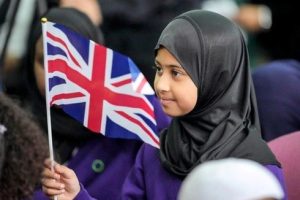
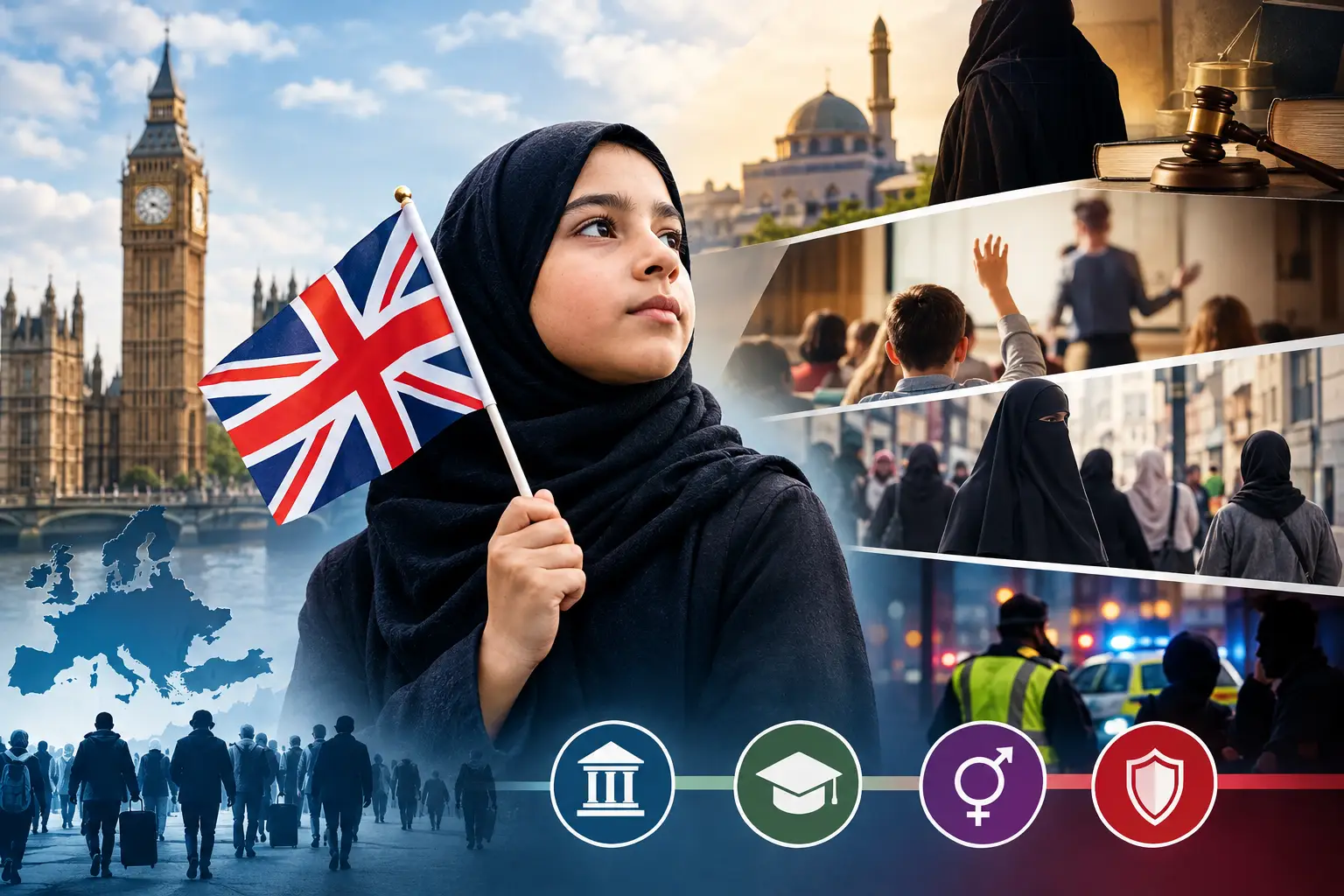
Muslim girl holding British “Union Jack” flag (File/AP)
Europe’s RMS Incompatibilities–
Similarly to Soft Crusades II, this section examines the UK, France, and Sweden. I’ll share and comment on examples that fall into four categories: 1) parallel structures, 2) education & free speech incidents, 3) gender norms & public space demands, and 4) crime & public order. These four categories should be thought of as indicators of RMC incompatibility. When these types of issues appear, policymakers should use them as qualitative evidence that immigration from the perpetrating immigrants’ countries needs to be evaluated further. A Sharia court to adjudicate marital disputes in the UK, for example, would be subverting the law for religious reasons. That particular adherence to Islam would therefore be incompatible with the UK’s RMC domains.
The reason we examine the RMC domain differences is because it’s upstream of politics. Ignoring these incompatibilities would mean changes in overall politics long term, hence the need to call these out lest the home country risks a soft crusade.
United Kingdom
Parallel Structures: Sharia courts are the easiest example to point to in the UK. Sharia councils have existed in the UK since the 1980s, but have come under scrutiny lately with the numbers rising (est. 80-85 in the UK at the high end) and reports of abuse. Originally, these courts were set up as a way for the Muslim community to involve their faith in marital affairs, similar to many religions. Jewish courts have existed for decades in the same fashion. The recommendations from these are reportedly non-binding and do not trump UK law.
The problem with these courts is the abuse that’s often reported. Baroness Caroline Cox wrote a lengthy report in 2016 and continues to document firsthand accounts of abuse. Reports document unfair treatment of women in marital disputes, council-sanctioned polygamy, discriminatory child custody policies and inheritance laws, and implicitly-sanctioned domestic violence.
Education & Free Speech: High-profile incidents highlight self-censorship and pressure on free speech. In 2021 at Batley Grammar School, a religious studies teacher showed a Charlie Hebdo-style cartoon of Muhammad during a lesson on blasphemy. This triggered protests outside the school, death threats, and the teacher (along with his family) going into hiding for years. The school suspended the teacher and issued an apology. Similar patterns of protests and curriculum pushback have occurred elsewhere when Islamic sensitivities are involved.
Gender Norms & Public Space Demands: Demands for gender-segregated spaces have appeared in universities and public facilities. Islamic student societies at institutions such as University College London (UCL) and others have hosted events with separate seating for men and women. Public swimming pools in some areas have offered women-only or Muslim women-focused sessions to accommodate modesty concerns. These accommodations often spark debate over equality and secular public space norms.
Crime & Public Order: Several large-scale grooming gang scandals revealed systemic failures. The Rotherham Inquiry (Jay Report, 2014) estimated at least 1,400 children (mostly White British girls) were sexually exploited between 1997–2013 by groups predominantly of Pakistani heritage. Similar scandals emerged in Telford, Oxford, Rochdale, and elsewhere. Reports highlighted authorities’ reluctance to act due to fears of being labeled racist, allowing abuse to continue for years.
France
Parallel Structures: We first examined laïcité in Soft Crusades II within the context of preventing debate. France has no formal equivalent to the UK’s Sharia councils due to the strict laïcité policy, which prohibits official recognition of religious courts. However, informal Sharia-based mediation and “Islamic reconciliation” sessions occur in many banlieues (French city suburbs) and Muslim communities. Mosques and community leaders often resolve family disputes, marriages, and divorces outside the secular legal system. The 2021 “separatism law” (Loi confortant le respect des principes de la République) was explicitly designed to combat these parallel structures by increasing oversight of mosques, foreign-funded imams, and homeschooling. Despite those changes, reports indicate that informal parallel structures continue to operate.
Education & Free Speech: The 2020 murder of Samuel Paty, a history teacher beheaded after showing Charlie Hebdo Muhammad cartoons in a lesson on freedom of expression, remains the most prominent example. The killer was radicalized and acted in response to online campaigns by parents and Islamist activists. The case led to widespread self-censorship in French schools regarding Islam-related topics. Similar incidents continue, including protests against teachers and curriculum content perceived as insulting to Islam. The French government has responded with increased protection for educators and reinforced civic education requirements.
Gender Norms & Public Space Demands: Demands for gender-segregated swimming pools, sports sessions, and university events have become common in areas with high Muslim populations. Some municipalities have offered “women-only” hours at public pools to accommodate religious modesty concerns. There have also been repeated controversies over full-face veils (burqas/niqabs), the wearing of hijabs in schools and public employment, and pressure for halal-only options in school cafeterias. The 2021 separatism law strengthened bans on religious symbols in certain public contexts and targeted “separatist” practices.
Crime & Public Order: France has seen repeated waves of riots in banlieues (e.g., 2005 and 2023 nationwide riots triggered by police incidents). High-concentration neighborhoods in Seine-Saint-Denis, Marseille, and Lyon show elevated rates of violent crime, drug trafficking, and “no-go” style areas where police and emergency services face hostility. Honor-based violence, forced marriages, and female genital mutilation cases are disproportionately reported among certain immigrant-origin communities. Official reports document overrepresentation of individuals from North African and sub-Saharan Muslim backgrounds in sexual violence and gang-related crime statistics:
Foreign nationals from African countries – including the Maghreb and excluding those with dual nationality – represent 3.5% of France’s population, according to Insee. In 2023, they accounted for 39% of suspects in transport offences (13 points more than in 2016), i.e. eleven times more than their “normal” demographic weight. This overrepresentation varies according to the type of offence, but it is still striking: African foreigners are seventeen times more likely to be suspects of non-violent theft in transport as compared to their share in the general population (60% of all profiles, 19 points more than in 2016), fourteen times more likely to be suspects of violent theft (50% of all profiles, 27 points more than in 2016), and eight times more likely to be suspects of sexual violence, as well as offences of contempt and violence against public officials. (INIR, 2024)
Sweden
Parallel Structures: Sweden does not officially recognize Sharia courts, but informal parallel structures have emerged in high-density immigrant neighborhoods. Muslim community leaders and imams frequently mediate family disputes, marriages, divorces, and inheritance issues according to Islamic principles. Reports document the existence of informal Sharia councils and “mediation sessions” that often pressure women into accepting outcomes that conflict with Swedish law on equality and individual rights. Parents are even “urged to correct values children encounter in Swedish schools and to turn to religious authorities if their children’s beliefs and thinking are not considered to follow the right line.” The government has acknowledged growing concerns about parallel legal norms in vulnerable areas.
Education & Free Speech: Swedish schools in high-immigration areas have faced repeated demands for halal-only meals, gender-segregated classes, and exemptions from certain curriculum topics (such as sex education or teachings on evolution and homosexuality). Teachers have reported self-censorship on topics related to Islam to avoid conflict or threats. High-profile cases include protests against teachers and incidents where students refused to participate in mixed-gender activities or challenged Western values in the classroom. Integration challenges in schools located in vulnerable neighborhoods are well-documented in official reports. In a recent example, an Islamic leader was seen teaching young Muslims that democracy is against the principles of Islam:
A man who calls himself Yosef Ahmad on social media has recently shared footage of himself telling young Muslims in Sweden that democracy is incompatible with their religion, because it gives politicians the mandate to decide what is ‘halal’ (allowed) and ‘haram’ (forbidden) instead of Allah. (Curzon, 2026)
Gender Norms & Public Space Demands: Demands for gender-segregated swimming sessions and public facilities have become common in cities like Malmö and Gothenburg. Several municipalities have introduced women-only hours at public pools to accommodate religious modesty concerns. There are also reports of pressure for gender-segregated sports, school activities, and university events. Honor-based violence, forced marriages, and control over women’s dress and behavior remain significant issues in certain communities, with official support programs created specifically to address them.
Crime & Public Order: Sweden has experienced a sharp rise in gang violence, shootings, and sexual offenses in recent years, heavily concentrated in vulnerable areas with high immigrant populations. Official Swedish Police and Swedish National Council for Crime Prevention (Brå) reports show significant overrepresentation of individuals with foreign (especially Middle Eastern and African) backgrounds in violent crime, sexual assaults, and gang activity. Areas classified as “vulnerable” or “very vulnerable” (such as parts of Malmö, Gothenburg, and Stockholm suburbs) often feature parallel norms where police face hostility and residents rely on clan structures rather than state authorities. These challenges contributed to Sweden’s major policy reversal on immigration after 2015.
Overall Trends
It’s clear that many of the Muslim-majority populations in Europe struggle with some key RMC subdomains, specifically with regard to women’s rights and free speech. Veiling requirements almost seem a non-issue when compared to segregated spaces by gender or implicitly-sanctioned domestic violence. The clashes with free speech are even more alarming than the treatment of women. Free speech is one of the most sacred Western values, if not the most sacred. The progressives that support this kind of unfettered immigration run the risk of losing that value long term and that’s the value that allows for progressivism in the first place.
The parallel structures also expose a trend: these structures don’t go away even when explicitly prohibited or governed by law in the home country. An informal structure almost always remains and it isn’t the same as a Catholic priest advocating for a couple to work through marital disputes instead of divorcing because marriage is sacred—it’s way more restrictive and often includes steep penalties, whether formal or informal.
These trends expose a gap between the West and strict adherence to Muslim norms. With the RMC domains in conflict, it’s only a matter of time and population for politics to be reshaped downstream.
Is Europe too far gone?
Europe’s willingness to tolerate differences in RMC domains is a result of the openness we see in Western values. In the West, we are taught to be tolerant and accepting of cultural differences. The problem is that these “cultural” differences aren’t differences in diet and holidays—they’re differences in key values that govern society.
Many of the mentioned countries have taken steps to curb immigration and stomp out practices hostile to Western civilization, but that simply isn’t enough. Harsh penalties, including lengthy prison sentences, deportations, and even death in some cases, have to be imposed in order to preserve the West. Anything less and these populations will seek to gain more of a foothold in politics and reshape their country. Not only that, but we have to be able to talk about these issues without fear of being called racist or xenophobic. Without a candid representation of the facts, policymaking is near impossible as discussed.
While not a Muslim issue, Keir Starmer, the UK PM, criticized JD Vance on his comments over the recent Nowak stabbing:
This stabbing was allegedly committed by a Sikh person, not a Muslim, but it exposes the exact problem with the progressive way of thinking in Europe: we can’t blame immigration because that would be racist. Well, the Sikh, Vickrum Digwa, was an immigrant and, reportedly, his whole family (also immigrants) tried to not only hide the murder weapon but to also shield themselves from accountability by calling Nowak racist repeatedly. This ultimately culminated in Nowak being handcuffed by Southampton police while saying he’d been stabbed, with one of the police officers saying on video “I don’t think you have, mate.” He then bled out on the ground while saying “I can’t breathe.”
The Nowak situation shows that the UK police officers were more afraid of not responding to the claim of racism than they were of being wrong about Nowak’s condition. This fear is even evident in the UK’s knife laws: Sikhs are able to carry their “ceremonial” knives while other British citizens are unable to be armed at all. Europe isn’t too far gone yet, but unless these situations are treated candidly and policymaking puts aside the racism charges, it’s only a matter of time.
Starmer calling Vance’s comments inflammatory and asking him to stay out of UK affairs is par for the course. Conservatives in the United States aren’t going to stop noticing and commenting on this, however. We don’t want to see the same problems extend across the pond.
Nathaniel Rendell is an American finance professional with about six years of experience in the consulting industry. He graduated from the University of Florida with a Bachelor of Science in Business Management and the University of Central Florida with a Master of Business Administration. He is the founder of and main writer for Union Brief, a publication providing conservative perspectives backed by research and data.
Be sure to follow him on Substack https://unionbrief.substack.com/