Support ASCF
If you liked this article, please share it with your friends and family. You can also help the American Security Council Foundation shape American policy.
Recent Articles


Soft Crusades IV: America’s Path Forward
Written by Nathaniel Rendell
Part 4 of 4 in Union Brief’s Series
In Soft Crusades, we’ve established a handful of ideas:
- Crusades are no longer the “hot” crusades of the past, but rather a gradual societal shift.
- Religion, or lack thereof, drives morals, cultures, and politics.
- Decades of relaxed immigration didn’t account for the downstream effects of religious conflict.
- Relaxed immigration can lead to large-scale demographic changes.
- When demographics change religious proportions in a country, moral and cultural changes can be expected downstream.
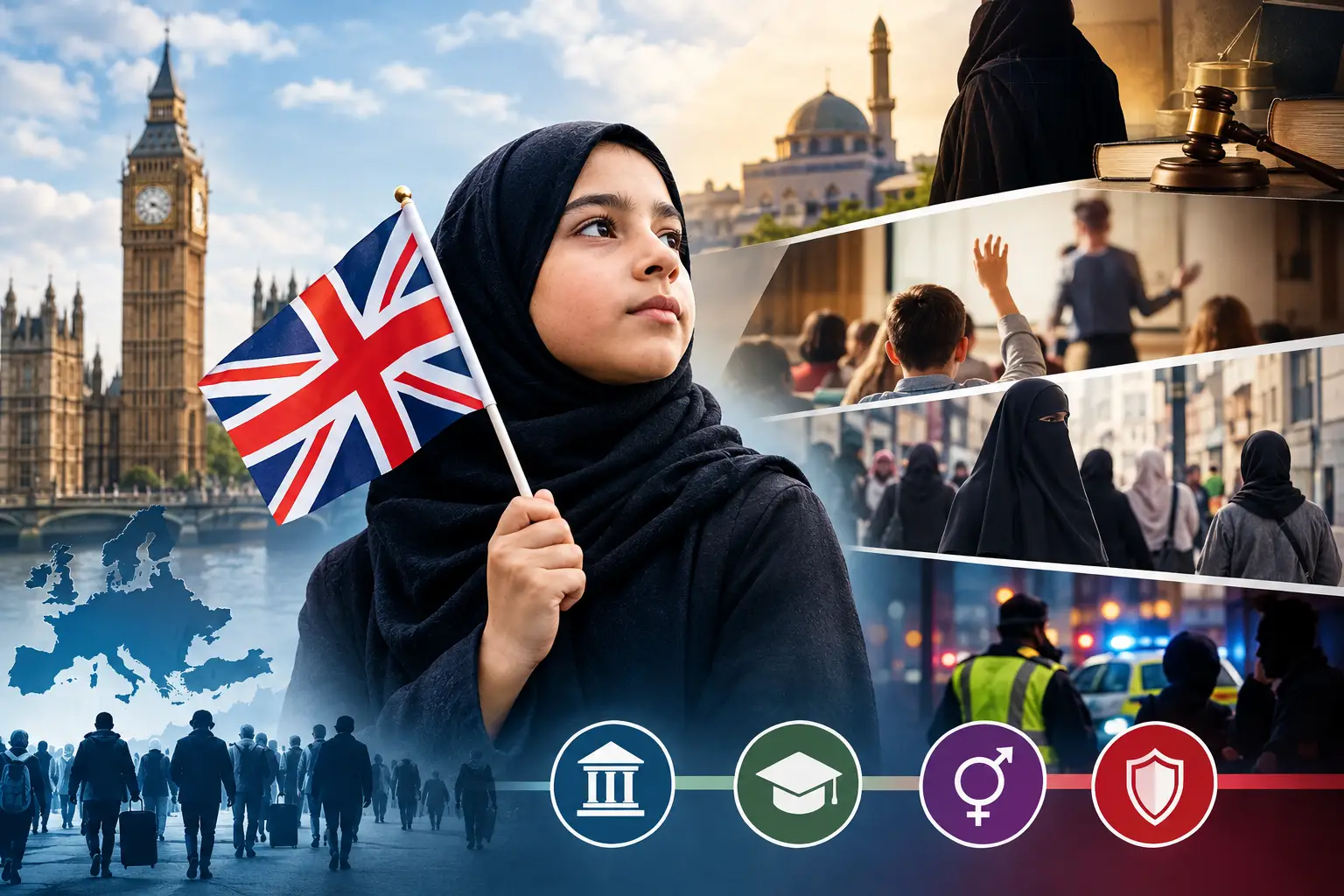
Europe is a cautionary tale of unfettered immigration and the effects. Not only that, but it’s a cautionary tale of what happens when the effects aren’t addressed properly. The UK is the easiest example to point to. The British Parliament has bent over backwards to accommodate religious minorities for multiple purposes: 1) fertility is below replacement rate for natives, meaning they need more people to keep their economy and age pyramid healthy, 2) liberals believe that diversity of religion within the UK is a net positive, and 3) liberals fear the charges of racism and/or xenophobia.
The most salient argument for their immigration policies is the idea that diversity of religion is a net positive.
There are plenty of issues described in Soft Crusades III, but are these widespread enough to justify immigration changes? And if it justifies tightening, how tight should the reform be?
In this final part of Soft Crusades, I’ll examine two questions:
- Is immigration tightening along religious lines justified?
- What does this mean for the United States?
Immigration, Indicators, & Inaction in Europe
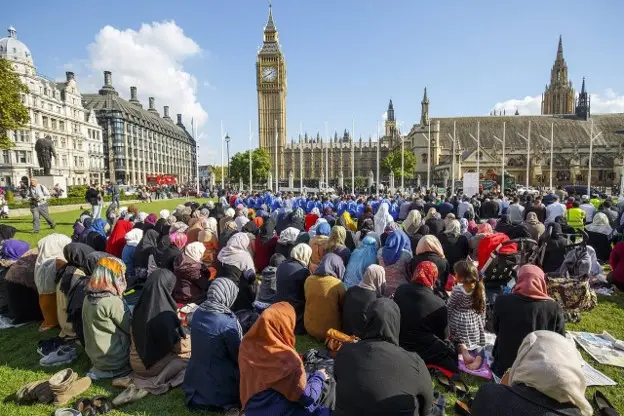
As stated, relaxed immigration policies combined with bleeding-heart liberalism have caused wave after wave of immigrants from countries all over the world, but immigration from the Muslim-majority countries has become the flashpoint in light of stories about gang rape, abuse, and Sharia courts. The issue has reached a boiling point with the recent formation of Restore Britain, a new political party promising not only to end immigration but enact remigration as well. I’ve included Rupert Lowe’s launch video for Restore Britain that went viral on X below:
Both sides of the global political aisle are making hay of the issue with Right-leaning politicians promising similar reform to Restore Britain and the Left-leaning politicians encouraging the same, or more, immigration. The Right has a peculiar history with immigration as some of their interests have aligned with increased immigration in the past—think back to the Republican support for LBJ’s Hart-Celler Act (Immigration and Nationality Act of 1965) in the United States. Increased immigration has a variety of benefits in theory: increased cultural mixing, increased supply of labor (drives down wages and pricing), better global relationships, etc. Most on the Right, however, have changed their tone on immigration, notably stressing the issues of crime and affordability—after all, those are the easiest effects to motivate the average voter.
In my opinion, the biggest problem with immigration lies in the long-term effects, especially when immigration is sloppy and non-exclusive. Short-term increases in crime are easy to fix with tough criminal penalties (leaving aside the current sentencing problems we’re seeing in the US with so-called “activist” judges), but what if the definition of crime is changed? With enough immigration from a foreign culture or religion, definitions can change—policy can change. On the Left, one might argue that the home country would mold the immigrant rather than vice-versa, taking the nurture over nature side in this argument. I agree that many immigrants can and will assimilate, but this is actually the reason why immigration considerations, specifically with regard to religion, are important: not all immigrants are willing, or able, to assimilate to their destination country.
The short-term impact of immigration in the form of increased crime rates, increased rent prices, etc. should be viewed as indicators for policymaking in the long term. Increased rent prices, for example, should be a clear indication that immigration should be halted until infrastructure and supply catch up. If we see Sharia courts in the UK, the UK government should be quick to either 1) investigate for abuse and stop if necessary or 2) halt immigration from countries whose immigrants are setting up the parallel courts. The problem we’re seeing in Europe in particular, is inaction in response to their short-term indicators.
Troubling Statistics Regarding Sharia Support
With short-term indicators in view, how widespread the differences are becomes the key question. Do enough Muslims subscribe to a version of their religion with vastly different moral and cultural pillars than the West? The answer, unfortunately, is yes.
NOTE: This data is from 2013, but it is still used as foundational data with regard to Muslim ideology within immigration debates.
Figures 1 & 2: Interpretation of Sharia Law as a % of Muslims (Pew Research, 2013)
Figures 3 & 4: Belief of Sharia Law Application as a % of Muslims (Pew Research, 2013)
Sharia law, while an anathema for the majority of the West, is not viewed unfavorably to most Muslims. This can be because their definitions may be different—some Muslims view Sharia as following the Five Pillars of Islam:
- Shahada (Declaration of Faith): The sincere recitation of the phrase, “There is no god but Allah, and Muhammad is the messenger of Allah.”
- Salah (Prayer): The performance of five obligatory, ritual prayers each day while facing Mecca.
- Zakat (Almsgiving): A religious tax and charitable obligation where Muslims who meet a specific wealth threshold donate a portion of their assets (typically 2.5% of accumulated savings) to the poor and needy.
- Sawm (Fasting): Fasting during the holy month of Ramadan. From dawn until sunset, healthy adult Muslims must abstain from food, drink, and sexual relations to develop self-discipline, humility, and empathy for the less fortunate.
- Hajj (Pilgrimage): A sacred pilgrimage to the holy city of Mecca, requiring every Muslim who is physically and financially able to make the journey at least once in their lifetime.
Other literalist interpretations, however, extend these pillars and adherence to Sharia law to other practices including veiling, polygamy, etc.
On its face, following the five pillars of Islam doesn’t come in conflict with the West. However, strict adherence to the religious pillars, especially when imposed on another population, does come into conflict with the West on some level. For example, zakat, as explored in Soft Crusades I, was in some cases used as a way of punishing religious minorities in the form of jizya. If Muslims reach, let’s say, 70% of the population in a country, do the politics start to mirror a theistic regime such as Iran? Do those not following shahada become persecuted?
A growing overall population will necessarily mean growth for the fanatics. The more Muslims that are imported, the more religious fanaticism can take hold—the Overton Window changes and begins to include more and more radical beliefs. It would be the exact same argument if we changed the word “Muslim” to “Nazi”—importing those who sympathize with an ideology means you’d likely import radicals. This is why immigration has to select for only those who buy into Western ideology and reject the radicals in their tent.
But it also in some ways doesn’t matter if the interpretation of Sharia is radical or not, Muslims that would institute it for non-Muslims should not be welcome in the West. It’s simply against our value of religious freedom. Nearly 200,000 Afghans arrived in the US under Joe Biden. 99% believe Sharia should be the law of the land in their home country and 61% believe non-Muslims should have to adhere to Sharia, with a single interpretation being the most popular view at 67%. Obviously those who self-select to migrate to the United States are likely predisposed to agree with some Western values, but the extrapolated number of those who believe Sharia should be law and non-Muslims should adhere could be as high as 120,780—and that’s just Afghanistan. A smaller number will be the radicals, but this is a significant population that would be fine with a Sharia reshaping of their new country.
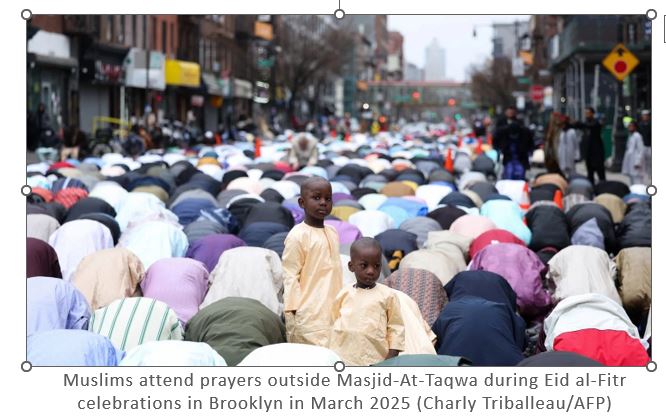
Muslims attend prayers outside Masjid-At-Taqwa during Eid al-Fitr celebrations in Brooklyn in March 2025 (Charly Triballeau/AFP)
Current US Situation
The United States is not Europe, but the early warning signs are visible. Official estimates place the Muslim population at roughly 1.1–1.3% of the total US population, but this this masks two things: 1) significant concentration and 2) the age pyramid. Dearborn, Michigan, and surrounding areas have Muslim majorities or pluralities in local governance and institutions. Similar patterns exist in parts of Minnesota (Somali communities), New Jersey, and certain urban pockets. Fertility differentials and continued immigration from Muslim-majority countries, combined with chain migration, suggest the same trajectory seen in Europe could accelerate if current policies remain unchanged.
Figure 5: % of Population by Religion and Age, United States (Pew Research, 2025)
Value gaps persist in polling: there’s higher support for Sharia elements among some American Muslim communities compared to the general population, lower assimilation metrics on issues such as gender roles, free speech, and secular governance. While many Muslim Americans are well-integrated, the data shows persistent pockets where RMC (religious/moral/cultural) incompatibilities mirror those documented in Europe.
3 Possible Trajectories for 2050
With Europe in mind, there are really three main options on the spectrum of immigration policy: 1) continued inertia, 2) stabilization through reform, and 3) a major reversal.
Continued Inertia (Europe Lite)
- High levels of low-skilled and family-based migration continue.
- Muslim population share grows to 4–8% nationally (higher in key states and cities).
- Parallel structures (informal Sharia mediation, demands for accommodations in schools and public spaces) emerge in concentrated areas.
- Crime and integration challenges increase in specific locales, leading to rising political tension and sporadic violence.
- Soft crusades advance incrementally.
Stabilization Through Reform (Smart Immigration)
- Policymakers implement selective, skills-based immigration with strong assimilation requirements (English fluency, civic knowledge tests, ideological vetting on core Western values).
- Chain migration and asylum abuse are curtailed.
- Fertility and cultural gaps narrow over generations.
- The US avoids Europe’s worst outcomes while still benefiting from high-value immigration.
Major Reversal (“Restore USA”)
- A political realignment leads to drastic reductions in overall immigration, mass deportations of criminal or non-assimilating elements, and explicit prioritization of cultural compatibility.
- Would entail remigration like Restore Britain.
- This path carries short-term economic and social costs but halts demographic momentum and preserves the historic American RMC framework.
Policy Recommendations
Both inertia and a major reversal are not politically viable in the United States. As much as liberals have lambasted President Trump for his use of ICE, the current MAGA position is, in fact, moderate. Deporting illegal immigrants and anyone who has abused the US system (e.g. the Somali immigrants who committed mass fraud in Minnesota) is the moderate position—it’s stabilization through reform and punishing non-law-abiding populations.
If liberals are okay with a soft crusade, they could go with inertia as the solution, but Trump won his last 2/3 elections running on immigration reform as his key position. And he won in spite of his political shortcomings—the US wanted these reforms. Kamala Harris even changed her tune on immigration during the election cycle much to the chagrin of hardline Leftists. Inertia just isn’t palatable for the majority of the US.
So what does stabilization through reform, or as I’d call it: “smart immigration,“ look like? It’s emotionless, practical immigration:
- Ending Chain Migration and Birthright Citizenship Abuses: Prioritize skilled, assimilable immigrants over extended family reunification.
- Ideological and Values Screening: Vetting for compatibility with core American principles (individual rights, secular governance, gender equality, free speech). Countries with high rates of Sharia support or honor-based violence should face stricter scrutiny.
- Assimilation Requirements: Mandatory English proficiency, civics education, and a formal commitment to American values for permanent residency and citizenship.
- Enforcement: Increase interior enforcement, end sanctuary policies, and deport criminal non-citizens promptly.
- Data Transparency: Begin tracking immigration outcomes by country/region of origin and religion (where legally feasible) to inform policy, similar to what Europe lacked for decades. We don’t need laïcité-style statistics in the United States.
- Cultural Confidence: Reject multiculturalism that treats all values as equal. Affirm that Western liberal democracy has superior outcomes on human rights, women’s status, and individual liberty.
The Choice Ahead
America still has time. Unlike many European countries, we are not yet locked into irreversible demographic momentum. The “soft crusades” dynamic is real but not inevitable here. The solution is not xenophobia or blanket bans—it is honest, interest-based immigration policy that puts American citizens and the preservation of our RMC framework first.
We do not need to become a mirror of 2050 Europe. The data, history, and European case studies provide a clear roadmap of what happens when nations ignore upstream religious and cultural realities. The question is whether we have the political will and intellectual honesty to act before the same patterns become entrenched. We have to have the courage to say that the West is best. Capitalism, freedom, individual rights, and gender equality are pillars to a successful civilization and have led to far more success and advancements than the alternatives. We’d be wise not to let our culture of openness destroy us from the inside.
The soft crusades can be halted. The window is still open—but it’s rapidly closing.
Nathaniel Rendell is an American finance professional with about six years of experience in the consulting industry. He graduated from the University of Florida with a Bachelor of Science in Business Management and the University of Central Florida with a Master of Business Administration. He is the founder of and main writer for Union Brief, a publication providing conservative perspectives backed by research and data.
Be sure to follow him on Substack https://unionbrief.substack.com/