
Support ASCF
If you liked this article, please share it with your friends and family. You can also help the American Security Council Foundation shape American policy.
Recent Articles
Singapore and the Future of Conditional Globilization
Written by Tom Raquer, Lt. Col., USAF (Ret.) Southeast Asia Foreign Area Officer
Why the Indo-Pacific’s Most Successful Trading State Matters Strategically
Few countries benefited more from the postwar international system than Singapore.
That is not accidental.
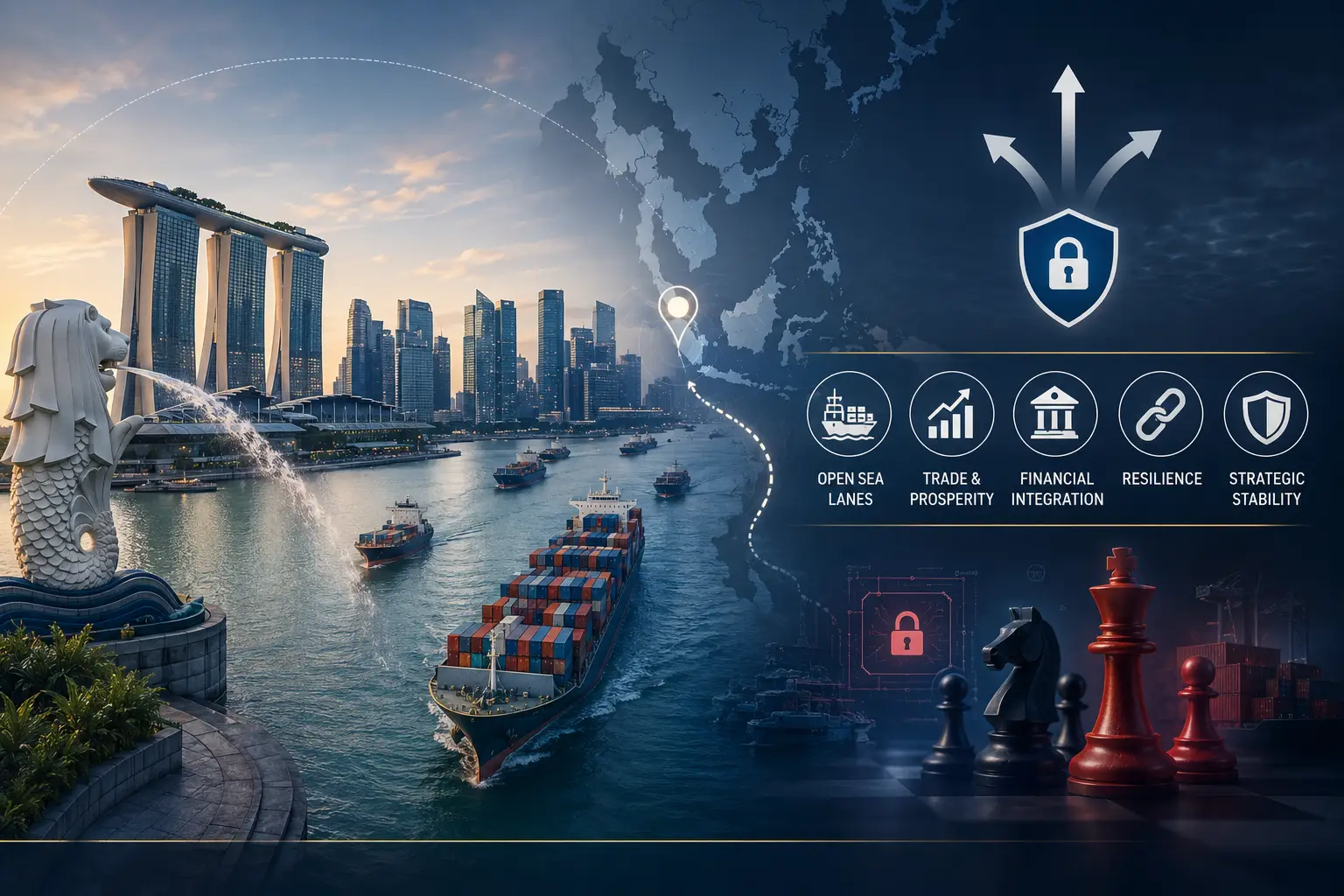
Singapore sits along one of the world’s most important maritime corridors. Its rise depended on stable shipping, open sea lanes, financial integration, and confidence that globalization would continue expanding over time.
For decades, that assumption looked reasonable.
The postwar order was built after two world wars and a global depression to reduce the likelihood that industrial powers would again collapse into catastrophic geopolitical rivalry. The system rewarded maritime openness, expanding trade, dollar liquidity, and economic integration. The aim was not simply prosperity. It was stability.
Singapore became one of the clearest success stories to emerge from that environment.
The Strait of Malacca evolved into one of the central arteries of global commerce. Energy flowed north into East Asia. Supply chains deepened. Financial integration accelerated. Stability itself became economically profitable.
But the assumptions supporting that system no longer look permanent.
The emerging geopolitical environment is becoming more fragmented, more competitive, and increasingly shaped by strategic pressure within the global system.
Globalization is not ending. But it is becoming more conditional.
Trade will continue. Shipping will continue. Financial systems will remain interconnected.
The Strait of Malacca remains one of the clearest examples of how geography continues to shape power. A substantial share of global trade and East Asian energy imports transits through maritime routes connected to Singapore and Malacca. The Indo-Pacific economy depends heavily on those flows remaining commercially reliable and strategically trusted.
However, physically closing a chokepoint is no longer necessary to create disruption. The question of whether systems stay trusted is becoming increasingly important. Even when routes remain officially open, commercial behavior can be altered by insurance pressures, cyber risk, sanctions, export controls, shipping insecurity, military conflict, and technological fragmentation.
Trade can continue while the system itself becomes less stable.
That is a major strategic shift.
For years, many governments assumed globalization would steadily reduce geopolitical rivalry. China appears to have approached the system differently. Beijing used globalization not only for economic growth but also to strengthen industrial depth, production capability, logistics, technological advancement, and strategic influence. Singapore’s increasing emphasis on resilience, supply-chain security, and strategic hedging suggests an awareness that the geopolitical environment supporting the postwar system is changing.
IMPLICATIONS OF POLICY
Singapore draws attention to a number of more general issues that the US and its allies must deal with. Because the continuous flow of products across vital sea lanes remains essential to prosperity, energy access, and supply chain continuity, maritime security remains the cornerstone of Indo-Pacific stability.
At the same time, strategic competition is increasingly taking place through supply chains, financial systems, economic networks, technology, and industrial capacity rather than solely through armed conflict. As a result, highly interconnected economies are becoming more vulnerable to disruption, technological decoupling, and geopolitical fragmentation. In this environment, resilience is becoming as strategically important as efficiency. Singapore’s response to these changing conditions may provide one of the clearest indicators of whether highly connected states can successfully adapt to an era of conditional globalization and persistent geopolitical competition.
Tom Raquer, Lt. Col., USAF (Ret.) Southeast Asia Foreign Area Officer