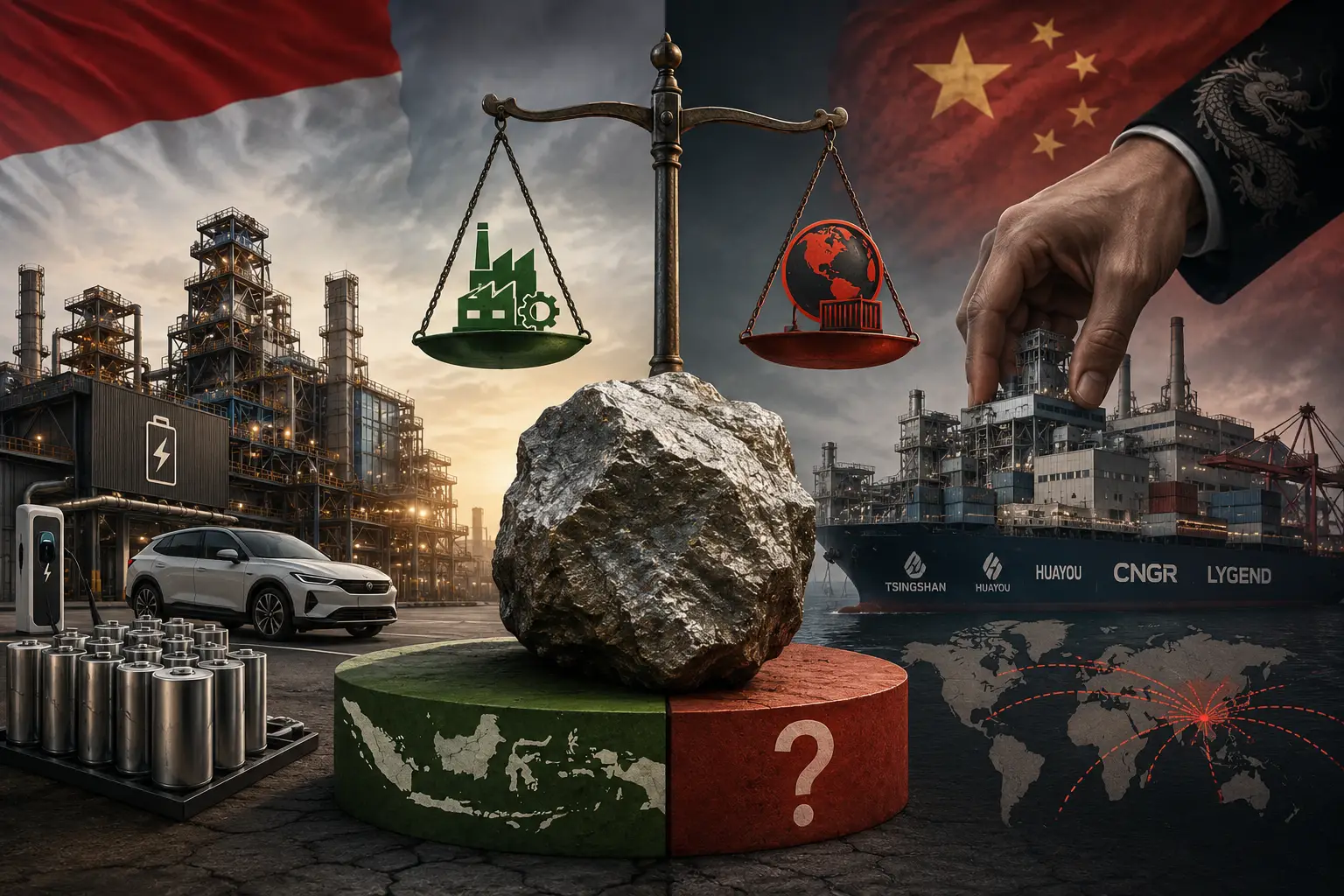
Indonesia’s 2020 ban on raw nickel ore exports was one of the boldest acts of economic nationalism in recent decades. Jakarta forced businesses to process nickel domestically rather than exporting raw materials in an effort to gain a larger share of the value chain and establish a domestic manufacturing base.
The policy has been successful by most economic metrics. Indonesia has created a rapidly growing battery manufacturing industry, drawn billions of dollars in investment, and emerged as the world’s top producer of refined nickel. Indonesia is now seen by many developing nations as an example of how industrial policy may spur economic growth.
However, the most crucial strategic question cannot be addressed by production numbers alone.
Economic autonomy and industrial capacity are not the same thing.
Chinese businesses have funded, built, and integrated a large portion of Indonesia’s downstream nickel industry into supply chains. Businesses, including Tsingshan, Huayou, CNGR, and Lygend, have been instrumental in the industry’s growth. Without a doubt, Indonesia has advanced on the industrial ladder. It’s still unclear if it will eventually own that ladder.
It seems that President Prabowo Subianto is aware of this difficulty. Jakarta is aiming to bolster Indonesian ownership alongside ongoing foreign investment by creating Danantara, Indonesia’s sovereign wealth fund, and other initiatives to boost domestic involvement in the battery supply chain. It’s unclear whether those initiatives will significantly strengthen Indonesian control over the sector’s long-term value.
The Indonesian case also underscores an essential lesson for the United States.
Washington has recognized key minerals as a strategic priority. However, American participation in Indonesia’s downstream nickel industry has remained restricted. China increased its influence through wealth, engineering know-how, industrial execution, and a readiness to invest at the scale Indonesia desired, rather than mainly through ideology or military connections.
Indonesia’s experience also shows that new strategic issues arise from industrial success. As the world’s nickel supply has increased, battery technology is still developing, and labor and environmental issues remain major concerns. As Indonesia’s economic reliance on a single external partner grows, its long-standing “free and active” foreign policy, known as Bebas dan Aktif, is under increasing strain.
Economic independence is not always ensured by political non-alignment.
Indonesia deserves praise for proving that a developing nation with abundant natural resources can transition from exporting raw materials to becoming a significant hub for the production of key minerals. However, economic sovereignty and industrial upgrading are not the same thing.
In the end, ownership, financial capacity, technological prowess, strong domestic institutions, and the ability to make national decisions free from excessive foreign pressure are all necessary for economic sovereignty.
Indonesia has proved that an industrial strategy can establish factories and advance a nation up the value chain. The unsolved strategic question is whether it will ultimately own the system it has helped construct. That divide offers an essential lesson not only for Indonesia but for every nation seeking strategic autonomy in a more competitive, multipolar world.
By Tom Raquer, Lt. Col. (Ret.), USAF | Foreign Area Officer for Southeast Asia