
Support ASCF
If you liked this article, please share it with your friends and family. You can also help the American Security Council Foundation shape American policy.
Recent Articles


China’s Perspective on the Iranian Conflict
Written by Tom Raquer Lt. Col. (Ret.), USAF
Southeast Asia Foreign Area Officer
Strategic Perseverance, Time, and Pressure
The US is concentrating on how to wage the Iranian conflict. China might be more interested in the long-term consequences of the conflict. It is not only an academic distinction. It presents two opposing perspectives on national power, competition, and strategy.
A DIFFERENT STRATEGY VIEW
In American strategic culture, war is often seen as an event. We focus on military operations, battle outcomes, negotiations, and the point at which an enemy is forced to surrender under duress. Time is often perceived as a limitation that needs to be controlled and surmounted.
Chinese strategic thought has often approached conflict in different ways. Beyond who will win the next battle, there are additional questions. What happens to the participants is the question. Which systems are experiencing strain? Who is responsible for the expenses? Over time, which side is more suited to absorb pressure?
This disparity is brought to light by the confrontation with Iran. In the West, military activities and the dangers of escalation have received significant attention. Beijing might be keeping an eye on something else. The impact of the dispute on energy markets, government finances, alliance relationships, industrial production, and public confidence may be as significant to Chinese policymakers as it is to others.
From that angle, there are no geographical restrictions on the battle. It becomes an endurance challenge.
USING TIME AS A STRATEGIC WEAPON
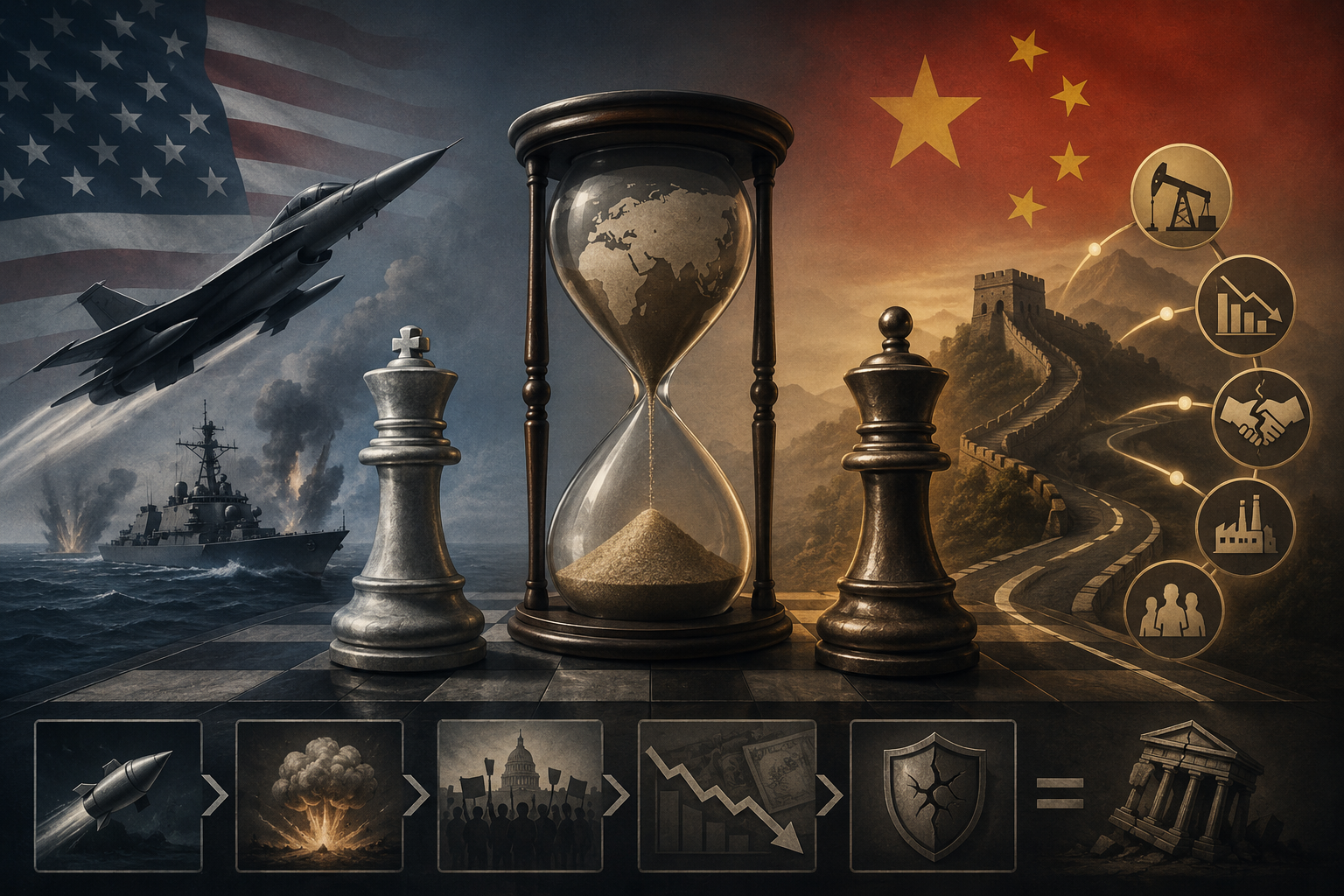
“Trading with the Sword in Hand” refers to an ancient Chinese geopolitical concept. The statement implies that the greatest way to get an edge is not always to engage in open combat. You can maintain your strength. You can make use of your time. Others’ instability could present an opportunity. Passivity is not what this is. It is intentional patience.
Beijing may determine that direct action is not required. A rival system’s ability to cover the expenses it places on itself may be revealed by the disagreement itself. Strategic consequences could result from a variety of problems, including growing debt, increased expenditures, industrial pressures, alliance conflicts, energy disruptions, and political divisions. China does not have to establish these criteria. It just needs to observe them.
This distinction keeps coming up in my research on Asian strategic cultures. The political and economic ramifications are just as important as the military results. The battlefield might not be the true test.
THE REAL TEST MAY NOT BE THE BATTLEFIELD
The Vietnam War illustrates the difference. The United States prevailed in numerous tactical battles during the conflict. Despite this success, the outcome was ultimately impacted by political pressure, declining popular support, and growing sustainability concerns. It turned out that military victory and strategic durability were different. A nation can do well on the battlefield while gradually weakening the political foundation required to sustain a lengthy fight.
After that, the query becomes internal. Can the economy withstand the pressure? Can businesses maintain their ability to inspire trust? Can partnerships last? Can the public continue to cover the national strategy’s expenses? These are essential components of a constitutional republic. These are components of strategy.
POLICY IMPLICATIONS
Public consent should be seen as a strategic instrument rather than a political afterthought if this evaluation is accurate. Strategy is intimately linked to industrial capacity, fiscal stability, energy security, and economic resilience. They are a component of the plan.
Policymakers must also acknowledge that rivals often pursue indirect advantages. It is not always possible to achieve strategic success in conflict. Sometimes it is accomplished by gradually building institutional, political, and economic advantages that make it harder for competitors to maintain their own positions.
Therefore, whether China can militarily beat the United States is not the main question. Whether the American republic can bear the expenses of a protracted geopolitical rivalry is the more crucial question.
The amplifier can be timed. The mechanism can be pressure. Military power may not be the only factor at work. Whether a political system can uphold the responsibilities it imposes on itself is the more crucial question. Of all the strategic questions, that one might be the most crucial.