Support ASCF
If you liked this article, please share it with your friends and family. You can also help the American Security Council Foundation shape American policy.
Recent Articles
More Lessons from the War on Terror
Written by Alan W. Dowd, ASCF Senior Fellow
By Alan Dowd, ASCF Senior Fellow
November 2026—Our October column began a discussion of lessons that can be gleaned from America’s post-9/11 campaign against terror. This issue continues that discussion.
The Taliban regime is an enormous part of the problem.
By mid-November 2001, CIA paramilitaries, Special Operations units, regular forces, and joint airpower—all supporting indigenous forces—had toppled the Taliban, flattened al-Qaeda, and liberated Kabul. With the Taliban overthrown, President George W. Bush faced a choice: declare victory, bring the troops home, and leave Afghanistan to the tender mercies of Taliban leftovers and Pakistan (which helped create the Taliban); or address the root causes of Afghanistan’s role in spreading terror and lay the foundations of a government committed to fighting terrorists rather than harboring terrorists. Bush chose the latter—and understandably so: Given that the Taliban and al-Qaeda shared the same worldview and same enemy, he concluded that eradicating al-Qaeda from Afghanistan was not enough to protect the United States. Thus, the small-footprint war of late 2001 morphed into a large-scale nation-building operation spanning nearly two decades.
The 20-year presence of American troops did not make Afghanistan as peaceful or stable as a Jeffersonian democracy or a member of the EU, but Afghanistan was undeniably more peaceful and more stable when American troops were there than it was before they arrived—or after they departed.
As alluded to in the previous column, one of the things America and its allies built for the Afghan people was a bridge back to civilization. Twenty-five years later, Afghanistan has yet to make it across that bridge. As long as the Taliban is in power, it won’t. That’s because the Taliban is today what it always has been: an enemy of civilization. The Taliban banished girls from school, ordered non-Muslims to wear identity labels, executed those belonging to opposing sects of Islam, turned soccer stadiums into mass-execution chambers, splashed acid onto teachers, used children to plant IEDs, and made common cause with bin Laden’s death cult.
Impatience is not a virtue.
Twenty years of warfighting, nation-building and peacekeeping is a long time—especially for the always-impatient American people. One recalls what President John Kennedy said in 1962, less than two decades into the Cold War: “I think our people get awfully impatient and may be fatigued and tired…saying ‘We have been carrying this burden for 17 years; can we lay it down?’” Kennedy’s answer: “We can’t lay it down, and I don’t see how we are going to lay it down in this century.”
But America did lay down the burden in Afghanistan, and that decision came with a price.
We can talk about the swift collapse of the Afghan military in August and September of 2021, but as Gen. H.R. McMaster explained and warned before the Taliban swept back into power, “The Afghan military was designed to have a very strong plug-in of U.S. firepower…Without that, they’re in trouble.”
His words proved prophetic. Without the enabling support and steadying hand of U.S.-NATO peacekeepers, the Afghan government and military melted away as the NATO stabilization force departed. The strawman argument that there was no middle-ground option between complete withdrawal and a multi-division occupation is belied by the highly successful initial phase of the post-9/11 campaign (which relied on a small footprint and focused on targeting the enemy); by the 18 months preceding the August 2021 pullout (during which there were no U.S. combat deaths); and by the Pentagon’s leadership (which recommended maintaining a backstop force of 2,500-4,000 troops).
What happens in Afghanistan doesn’t stay in Afghanistan.
The collapse and chaos in Kabul have done damage to the cause of democracy globally.
First, it pays to recall that the Trump administration’s peace talks with the Taliban left out Afghanistan’s democratic government—and that Afghanistan held seven free and fair elections between 2001 and the Taliban’s return in 2021. Thus, America’s abandonment of Afghanistan was an abandonment of a democracy—a flawed and fragile democracy, to be sure, but a democracy no less.
Second, the pullout sent a terrible message to Taiwan, Ukraine and other democracies in the crosshairs—and to their foes in Beijing, Moscow and Tehran. Iran’s president, for example, cheered America’s “military defeat” in August 2021. His proxies in Hezbollah chimed in: “Let all the allies of America watch the fate of all those who put their faith in it.” China’s state-run media mouthpiece declared that Washington’s “desperate withdrawal plan shows the unreliability of U.S. commitments.” Vladimir Putin mocked America’s “desire to build democracy in other countries.”
Our allies deserve better.
More than 50 nations contributed troops to the Sisyphean mission in Afghanistan. They made real sacrifices: 455 Brits, 158 Canadians, 86 French, 54 Germans, 48 Italians, 43 Danes, 41 Australians, 40 Poles were killed in Afghanistan. All told, 1,144 troops from allied and partner countries died in Afghanistan alongside 2,465 Americans. Too many Americans fail to grasp how big our country is: Denmark’s loss of 43 troops is proportionally equivalent to 2,424 Americans.
Most of the foreign troops that fought and died in Afghanistan were from NATO member states. NATO led the Afghanistan mission. In fact, the only time NATO’s all-for-one collective-defense clause has ever been invoked was after 9/11. By early 2021—nearly 20 years after the attacks on America’s capital, America’s military headquarters, America’s largest city—74 percent of the foreign troops deployed in the country that spawned 9/11 were not Americans.
Yet when Washington decided to pull out of Afghanistan, NATO allies were not consulted so much as notified that President Joe Biden was moving forward with President Donald Trump’s pullout plan. The plan was bad; the way it was implemented was worse. The chaotic withdrawal damaged NATO’s unity and credibility. “It is the biggest debacle that NATO has suffered since its founding,” concluded a German official. A British MP declared, “The special relationship is very, very damaged.” Some U.S. officials draw a line connecting NATO’s chaotic pullout from Afghanistan in August 2021 with Putin’s lunge at Kiev in February 2022.
Ending U.S. involvement didn’t end the war.
By the middle of the Obama administration, Americans concluded that they had given Afghanistan enough time, enough blood, enough treasure. Thus, President Barack Obama began what he called a “drawdown” from the land that spawned 9/11, declaring, “It is time to focus on nation building here at home.” Using the same language, Trump said, “We have to build our own nation,” and began hammering out a deal with the Taliban. Biden carried out that deal. “I’m now the fourth United States president to preside over American troop presence in Afghanistan,” Biden observed. “I will not pass this responsibility on to a fifth…It’s time to end the forever war.” Just as Trump echoed Obama, here Biden echoed Trump, who argued, “Great nations do not fight endless wars.”
Gen. David Petraeus counters Obama, Trump and Biden by noting that “ending U.S. involvement in ‘endless wars’ doesn’t necessarily end the wars…it just ends our participation…The cost of retaining a few thousand troops in Afghanistan pales in comparison with the price the nation will pay strategically and economically if al-Qaeda or ISIS rebuilds a terrorist platform there.”
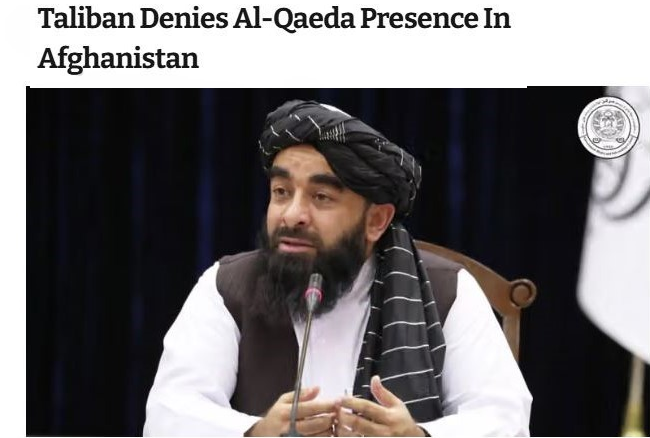
The Manhattan skyline offers a reminder of what that price entails. Today, al-Qaeda has eight training camps in Afghanistan, and there are more than 4,000 ISIS-K terrorists based in Afghanistan.