
Support ASCF
If you liked this article, please share it with your friends and family. You can also help the American Security Council Foundation shape American policy.
Recent Articles


Remembering the Other Anniversary
Written by Alan W. Dowd, ASCF Senior Fellow
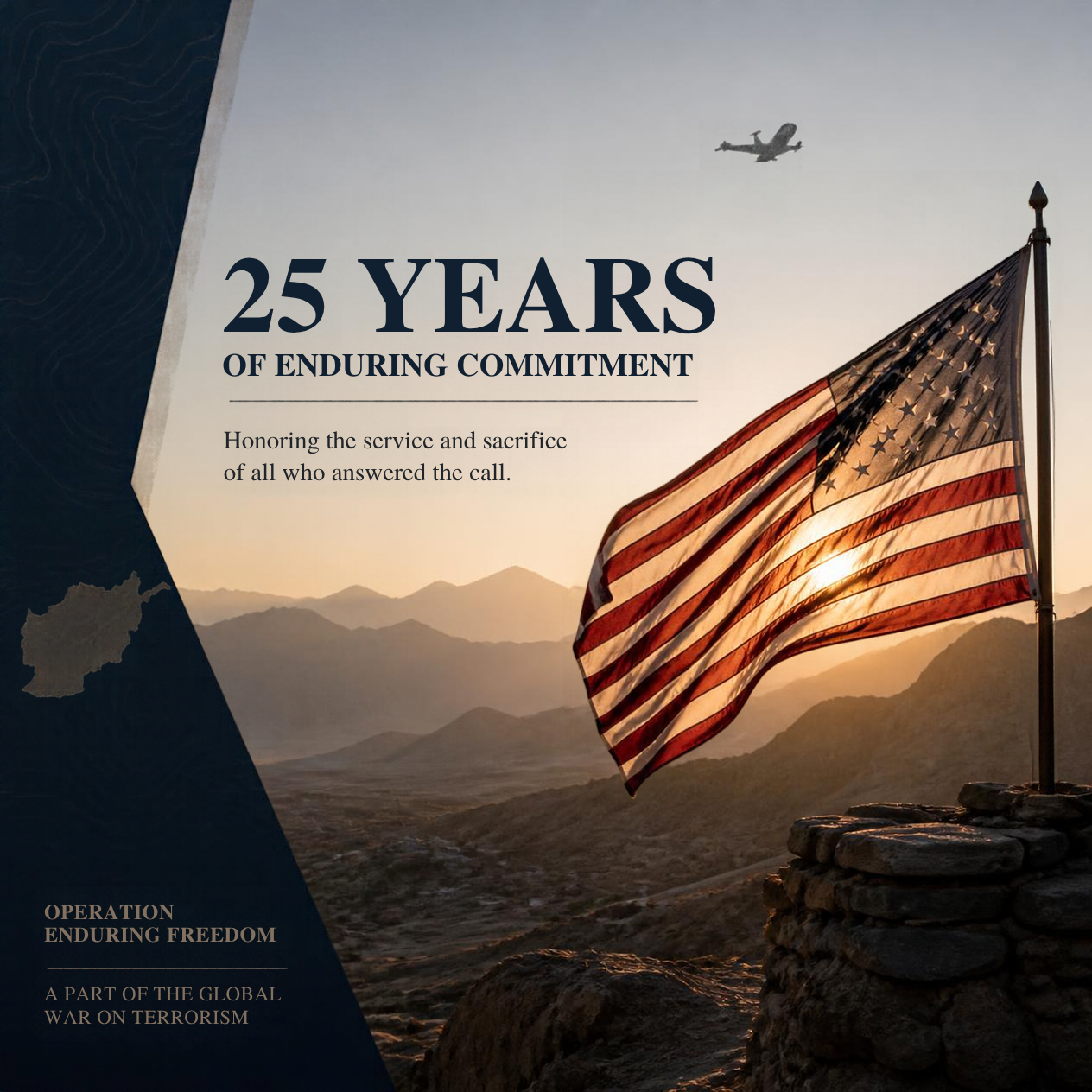
October 2026—Most Americans took a moment to remember the 25th anniversary of the September 11 attacks last month. Few will stop to remember America’s military response to those attacks, which began 25 years ago this month, on October 7, 2001. There are many lessons to be gleaned from this other anniversary.
>Average Americans led the way.
America’s counterstrokes against al Qaeda—what came to be called the global war on terror (GWOT)—actually began before October 7, when the passengers and crew of United Flight 93 mounted a heroic effort to wrest control of their hijacked plane. They quickly cut through the fog of war, refused to negotiate or apologize or retreat, and took the fight to the enemy.
By circumstance, their plane was doomed to play a part in history on September 11, 2001. But by choice, they would change history and spare their countrymen yet another trauma: As the 9/11 Commission concluded, the objective of Flight 93’s hijackers was to attack “symbols of the American Republic: the Capitol or the White House.” But the enemy was “defeated by the alerted, unarmed passengers of United 93.” They “were the first people to inhabit the post-9/11 world,” notes Paul Greengrass, director of the film United 93. They left us a blueprint for dealing with our jihadist enemies—a blueprint other air travelers and America’s military would follow.
>Large-scale military campaigns demand congressional buy-in.
What began on Flight 93 continued on October 7, 2001—the day U.S. forces invaded Afghanistan. To his credit, President George W. Bush sought and received congressional authorization for the military campaign that began in Afghanistan and extended to the Philippines and the Horn of Africa, to Niger and Syria, to Pakistan and literally all the way to Timbuktu. Bush also secured congressional authorization for the campaign in Iraq—quite unlike other presidents, who have ordered U.S. military operations in Iran, Nigeria, Venezuela, the Caribbean Sea, Syria, Libya, Bosnia, Kosovo, Afghanistan, Sudan, Somalia, Panama, the Persian Gulf, Grenada, Libya (yet again) and Iran (yet again) without seeking congressional approval.
To be sure, presidents have unique authority under the Constitution to wage war. After all, the Constitution describes the president as “commander-in-chief.” Presidents must have the flexibility to act swiftly in defense of American interests. At the same time, presidential war-making power should not undermine the unique authority the Constitution accords Congress in determining when U.S. forces should be put into harm’s way. As Madison observed, “The Constitution supposes what the history of all governments demonstrates, that the Executive is the branch of power most interested in war and most prone to it. The Constitution has accordingly…vested the question of war in the Legislature.”
Congressional authorization should never be seen as a hindrance. In fact, Congress can help the president by conferring legitimacy onto a military operation, by sharing the burden and responsibility of intervention, or by rejecting plans for intervention and thus preventing the president from launching a military operation lacking popular support.
Of course, securing congressional support for military operations doesn’t guarantee success. But it does commit Congress—and by extension, the American people—to a military campaign, which is especially important when faced with long and costly interventions. Indeed, one of the reasons the effort in Afghanistan was sustained across so many years is congressional buy-in from the beginning.
>The war on terror may not be in the headlines, but it’s far from over.
To those who were listening, the length and open-ended nature of the GWOT are no surprise. Days after 9/11, Bush braced Americans for “a lengthy campaign unlike any other we have ever seen.” In October 2001, Adm. Michael Boyce, then-Chief of the British Defense Staff, speculated that the GWOT “may last 50 years.” Indeed, while other threats dominate our newsfeeds today—great-power conflict with Russia, a new cold war with China, a monthslong hot war with Iran, North Korea’s nukes—the threat posed by jihadist terrorism hasn’t disappeared.
As it did before October 7, 2001, al-Qaeda continues to collaborate with the Taliban. There are al-Qaeda training camps and schools across Afghanistan. It’s noteworthy that al-Qaeda leader Ayman al Zawahiri was killed in Kabul a year after the U.S. pullout. As it did before October 7, 2001, the Taliban provides safe haven to multiple jihadist groups. Pakistan reports that terrorists based in Afghanistan have killed nearly 5,000 Pakistanis over the past three years.
In 2025, al-Qaeda offshoot ISIS conducted attacks in Syria and Australia. Earlier this year, Gen. Dagvin Anderson (AFRICOM commander) reported that ISIS “remains a threat to the homeland,” which helps explain why the campaign against ISIS (Operation Inherent Resolve) continues—and why the Pentagon just deployed 1,200 soldiers to the Middle East to support that campaign. JNIM—a collection of al-Qaeda affiliates in western Africa—has killed or captured hundreds of Malian citizens and military personnel. Another al-Qaeda partner, al-Shabaab, is attacking U.S. forces in eastern Africa. The past three years have seen U.S. forces conduct hundreds of strikes—86 this year alone—against al-Shabaab, al-Qaeda, ISIS and their brethren across AFRICOM’s footprint.
In short, what some in the defense community aptly call “the long war” is far from over.
>September 11 changed the DNA of U.S. national-security strategy.
Whether Saddam Hussein’s Iraq was a central front in the war on terror (as Bush concluded) or to be avoided as a “dumb…rash war” (as President Barack Obama contended), Saddam Hussein’s Iraq undeniably engaged in terrorism; bankrolled and harbored terrorist groups; developed and used WMDs; and played games with the UN about the whereabouts of WMDs. In playing those games, Saddam failed to grasp that 9/11 had changed the very DNA of U.S. national-security strategy. “Any administration in such a crisis,” historian John Lewis Gaddis writes, “would have had to rethink what it thought it knew about security and hence strategy.” Was deterrence possible? Was containment viable? Was giving repeat-offenders like Saddam the benefit of the doubt responsible? The Bush administration’s answer to each of those questions was “no,” which is why 9/11 led first to Afghanistan and then to Baghdad.
This is how 9/11 is linked to Saddam’s Iraq: The latter didn’t plan the former, but the former taught Washington a lesson about the danger of failing to confront threats before they are fully formed. In the same manner, the appeasement of Hitler had nothing and yet everything to do with U.S. national-security strategy during the Cold War.
>The campaign that began on October 7, 2001, was successful.
The post-9/11 campaign of campaigns has been long (25 years and counting), expensive (approaching $6 trillion) and costly in lives lost (nearly 7,000 Americans have been killed in what one historian calls “the wars of 9/11”). It also has been successful.
The central aim of the GWOT was to dismantle terrorist groups and their sponsors, shift the battlefront away from our shores, and prevent the homeland from being maimed again. By that measure, the GWOT has succeeded. The debate over whether it was worth the costs will go on for decades. (A half-century after the fall of Saigon, Americans still debate our involvement in Vietnam.) But the successes of the GWOT cannot be debated: It put the enemy on the defensive and forced the enemy to expend limited resources on survival. Many of our enemies haven’t survived. Along with bin Laden, Zawahri, Baghdadi, Saddam and Soleimani, al-Qaeda operations-chief Muhammad Atef, Taliban leader Muhammad Omar, AQI leader Musab Zarqawi, AQAP leader Anwar al-Awlaki—terrorists all—have been sent to wherever mass-murderers go after meeting their Maker. Tens of thousands of their henchmen have been killed. September 11 mastermind Khalid Sheikh Mohammed is in a cage in Guantanamo Bay. Iraq is no longer a patron state of terror. The ISIS caliphate is gone.
Although the wars in Iraq and Afghanistan have scarred America deeply, it pays to recall that America’s military liberated 24 million Iraqis and 22 million Afghans from horrific regimes—and built for them a bridge back to civilization. Iraq has limped across that bridge—casting off dictatorship, embracing representative democracy, renouncing terrorism and WMDs, respecting its neighbors, promoting stability in its neighborhood rather than spreading chaos.
The picture and prognosis aren’t nearly as good in Afghanistan, which looks like it did before October 7, 2001—a grim reality we will discuss in part two of this series.