

Support ASCF
If you liked this article, please share it with your friends and family. You can also help the American Security Council Foundation shape American policy.
Recent Articles




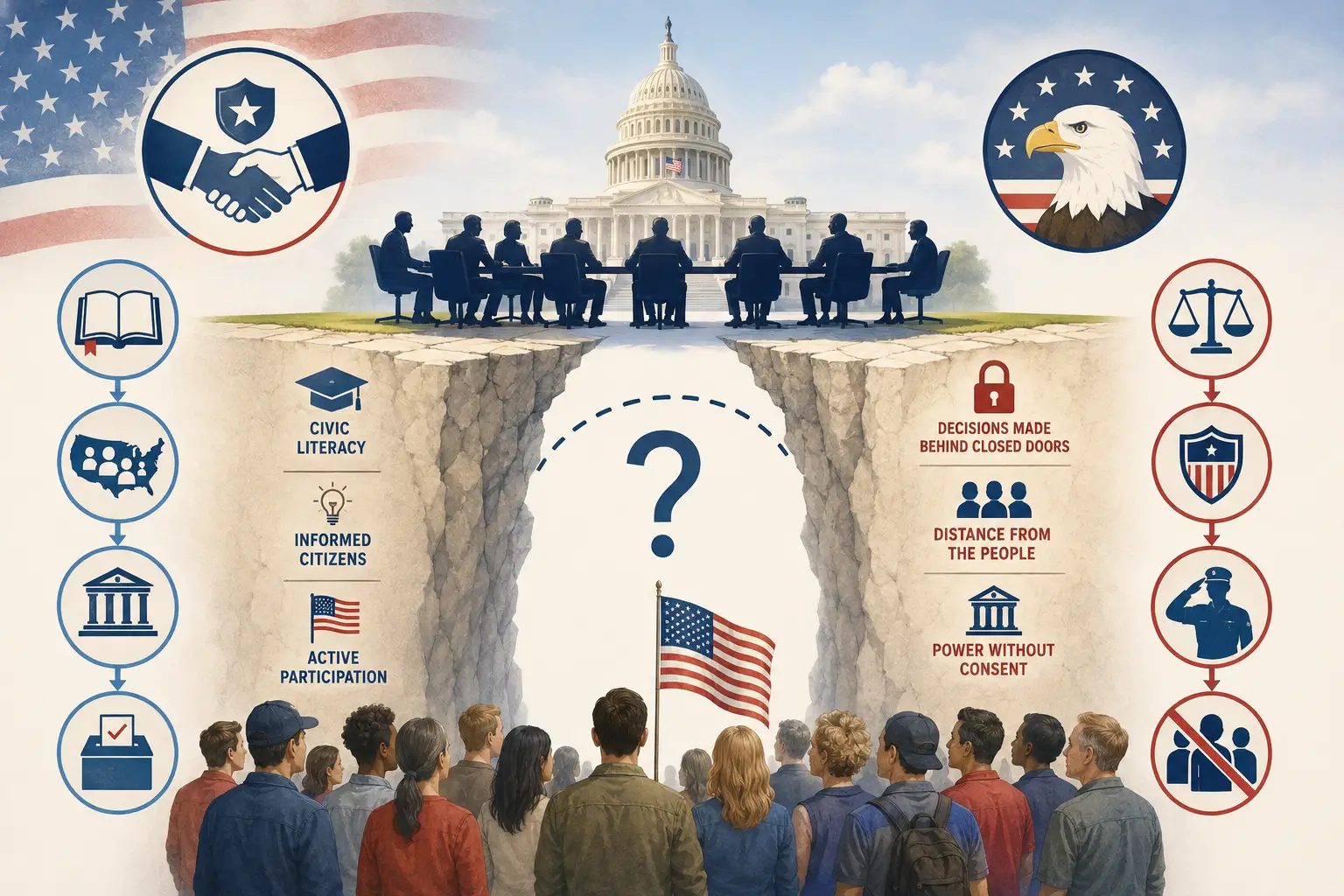
The Growing Deficit of Consent in the Republic
Written by Tom Raquer - Col. (Ret.), USAF, Southeast Asia Foreign Area Officer
We are frequently informed that Americans live in a republic of self-government. But on many of the nation’s most important problems, citizens are learning about critical decisions only after they have entered the policy process.
Recent discussions on the probable merging of parts of the American and Israeli defense establishments illustrate the dilemma. What is important is not whether one is for or against such measures. The more disturbing question is why most Americans have no idea that these debates were going on.
This is significant because military groups are not typical instruments of government. They create alliance pledges, security guarantees, strategic priorities and future courses of action that often outlast the political careers of those who make them.
The plan itself is thus less important than what it reveals: a growing disconnection between the citizens and the institutions that are deciding on the people’s behalf.
THE GAP IN CONSENT AND CIVIC ILLITERACY
A second trend makes this divergence even more worrisome.
The erosion of civics education has eroded the public’s knowledge of how a constitutional republic is supposed to work. National tests reveal that just a small percentage of American students are proficient in civics and American history. When citizens lose practical knowledge of constitutional government, they become less able to recognize when their influence over public affairs is diminishing.
The effect goes well beyond the classroom.
It is getting harder for citizens to distinguish constitutional questions from political arguments, legal matters from cultural disputes, and significant national security questions from ordinary policy conflicts. Without civic literacy, public conversation is not informed and deliberative, but rather fragmented and reactive.
The ramifications for modern arguments over immigration, national identity, constitutional government, and political Islam are obvious.
The American constitutional order originated in a Western political tradition that steadily distinguished religion from political authority, asserted the primacy of civil law, and vested power in citizens. When its members no longer grasp the basic ideas it is supposed to understand, a republic can not make a reasonable judgment of rival ideologies.
WHEN THE SOVEREIGNTY OF THE CITIZEN IS THE SYMBOL
A republic can maintain its outer forms while still losing the substance of democratic participation. Major decisions are taken by bureaucracies, networks of experts, and advocacy organizations that most voters do not fully comprehend or cannot effectively influence. The public pays the price in terms of taxation, military service and economic costs.
This results in an increasing disconnect between constitutional theory and political practice.The citizen is still sovereign in law, but is growing increasingly remote from power in fact.
POLICY IMPLICATIONS
The Framers understood that representation was meant to convey the people’s desires to government, not to shield government from the people.
Consent is not permanent. It must be refreshed with civic education, constitutional literacy, transparency and active involvement in public life. When individuals stop believing in the importance of their permission, trust breaks down, legitimacy shrivels, and polarization widens.
The worst danger is not disagreement. The greatest danger is that decisions of long-term national importance are being taken before the person even knows there is a choice.
A constitutional republic is not just about elections. It depends on citizens knowing, being confident and having the civic competence to govern themselves in a real sense.
The real question is not whether the republic still holds elections. The question is whether the citizen is still the republic’s real centre of gravity.
If citizens do not understand how their republic operates, they cannot meaningfully consent to its governance. And when permission is symbolic rather than real, self-government becomes increasingly indistinguishable from administration.
The republic might have its institutions. But it also risks losing its citizens, slowly.