

Support ASCF
If you liked this article, please share it with your friends and family. You can also help the American Security Council Foundation shape American policy.
Recent Articles

Permission, Not Passage
Written by Tom Raquer
Maritime Risk and the Limits of Control
IN MODERN MARITIME COMPETITION, ACCESS ALONE NO LONGER GUARANTEES MOVEMENT. RISK INCREASINGLY DETERMINES WHAT ACTUALLY FLOWS.
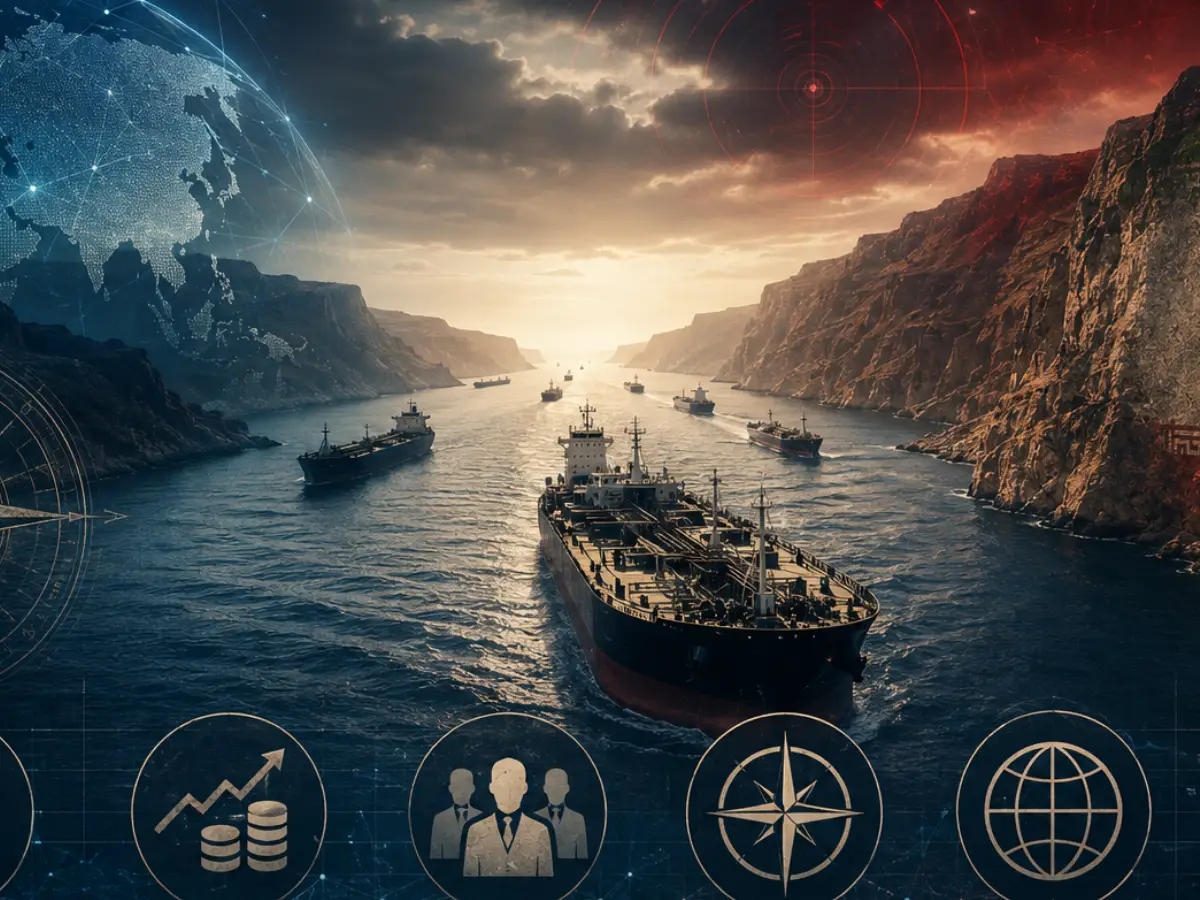
The Strait of Hormuz is still open. A few years ago, that would have settled the discussion. Now it does not.
Ships continue to move through the waterway, but not normally. Insurance costs have climbed sharply. Charter negotiations take longer. Some operators are rerouting cargoes altogether. The route technically functions, yet the commercial system surrounding it is increasingly uneasy.
That shift matters. For decades, much of American strategic thinking rested on a simple assumption: secure the sea lane, keep military superiority, and commerce continues to flow. Deny access, and pressure builds until the other side gives way.
But that is no longer how the system behaves.
Movement today depends less on whether the passage physically exists and more on whether participants judge the risk acceptable. That sounds like a subtle distinction.
It is not.
Hormuz illustrates the point clearly. One-fifth of globally traded oil and significant LNG volumes transit the strait. Yet Iran does not actually need to close the waterway to create disruption. The possibility of escalation alone can alter decisions made by insurers, financiers, shipowners, traders, and energy markets.
That process usually unfolds quietly at first. Tankers reroute before governments issue formal statements. Insurance markets react before political leaders publicly acknowledge instability. Financing becomes more expensive. Delays accumulate across the system long before a headline announces a crisis.
The route can remain technically open while movement becomes increasingly constrained in practice. Recent reporting suggests that some LNG, LPG, and commercial traffic continue to transit Hormuz under heavily constrained conditions, even as overall movement remains well below normal commercial levels.
That distinction matters because policymakers still tend to think in binary terms: open or closed, war or peace, access or denial. Modern maritime systems no longer work that way consistently. They function inside a spectrum shaped by uncertainty, insurance exposure, financial hesitation, and political risk.
The implications extend well beyond the Gulf. The post-Cold War trading system depended heavily upon the assumption that the United States could guarantee stable maritime commerce at scale. Over time, markets absorbed that assumption as a permanent condition of globalization.
Now the environment is changing. Supply chains are becoming more politically conditioned. Energy routes are increasingly exposed to geopolitical pressure. Regional powers are pursuing their own interests inside a more fragmented and multipolar system.
Under those conditions, military superiority still matters. But it no longer automatically decides economic behavior. Participation matters too. And participation increasingly depends on risk tolerance.
That creates a vastly different strategic environment. Pressure can appear without blockade, declared war, or direct interruption of passage. Systems under strain rarely collapse all at once. More often, they slow down, reroute, hesitate, and absorb mounting friction until behaviour across the structure begins to change.
That carries serious implications for American strategy. Future competition will depend not only on force projection, but also on:
- resilience,
- industrial capacity,
- energy security,
- supply-chain redundancy,
- and the ability to sustain participation under pressure over time.
And in constitutional republics, those pressures eventually reach the citizens directly. Inflation, energy costs, and supply-chain instability are not separate from national security. Over time, they shape whether the strategy stays politically sustainable.
The Strait of Hormuz is not simply a regional flashpoint. It is a warning about how strategic competition increasingly works in a fragmented world.
Permission increasingly matters as much as passage itself.
BIO
Tom Raquer is a retired U.S. Air Force lieutenant colonel, Southeast Asia Foreign Area Officer, and geopolitical risk analyst focused on maritime security, energy systems, and strategic sustainability in an era of systemic transition. He writes as The Citizen’s Strategist.