

Support ASCF
If you liked this article, please share it with your friends and family. You can also help the American Security Council Foundation shape American policy.
Recent Articles



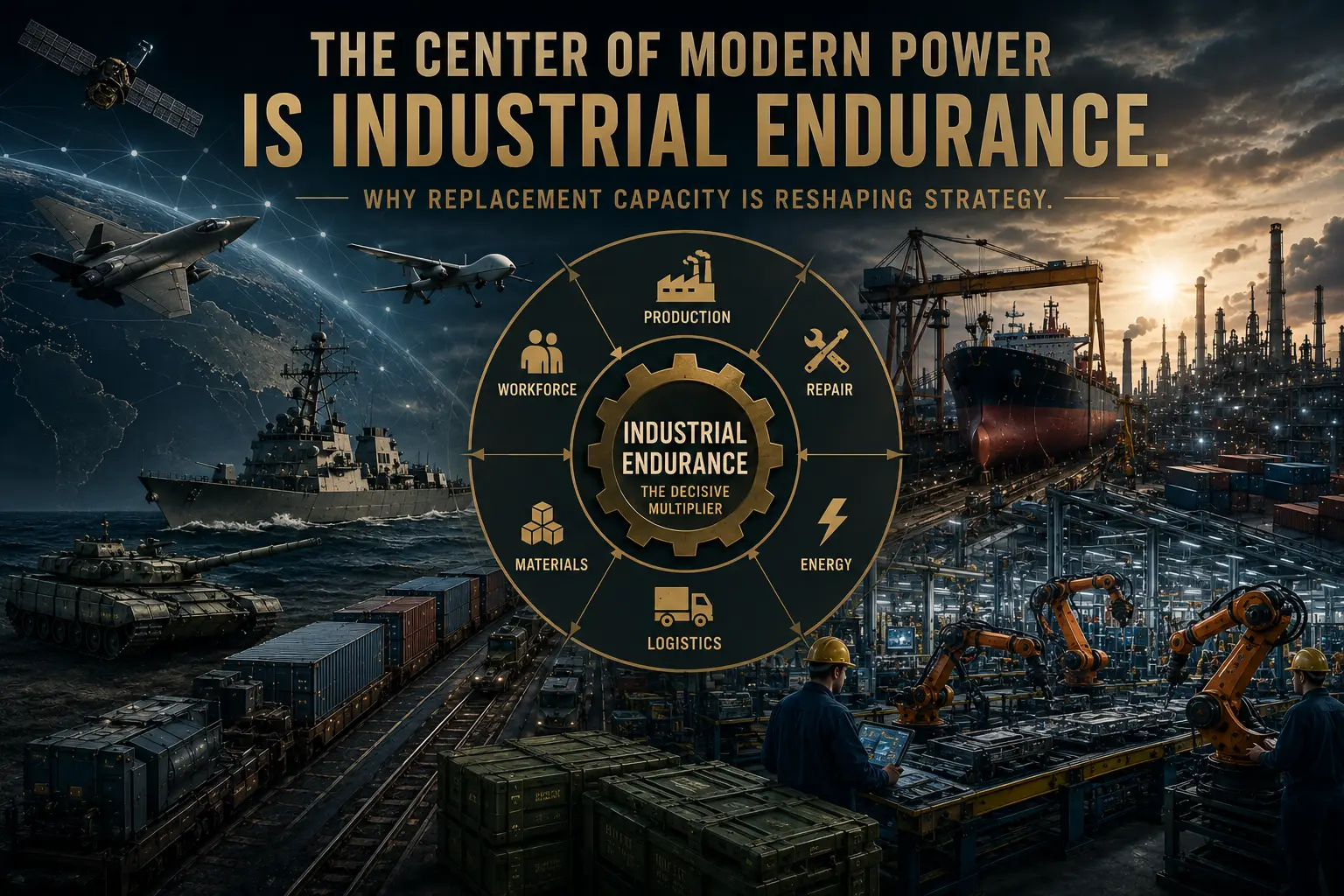
THE CENTER OF MODERN POWER IS INDUSTRIAL ENDURANCE. Why Replacement Capacity Is Reshaping Strategy
Written by Tom Raquer, Lt. Col., USAF (Ret.)
THE CENTER OF MODERN POWER IS INDUSTRIAL ENDURANCE. Why Replacement Capacity Is Reshaping Strategy
For years, much of American strategic thinking assumed advanced technology would decide wars long before industrial exhaustion became a serious problem.
Precision weapons, global logistics, financial power, and networked warfare seemed to reduce the importance of manufacturing depth and replacement capacity that shaped earlier industrial conflicts.
The emerging strategic environment suggests that the assumption may have been premature.
The war in Ukraine has burned through artillery ammunition, missiles, drones, armoured vehicles, and air-defence systems at rates that surprised many Western planners. Meanwhile, instability in the Red Sea and rising tensions around Taiwan continue to expose the extent to which modern military power remains dependent on shipbuilding, logistics, energy systems, and industrial supply chains.
Modern war still depends on industrial depth.
Technology matters. Training matters. Battlefield leadership matters. But long wars also place pressure on ports, railways, repair facilities, electrical grids, energy reliability, and the industrial systems supporting military operations.
Wars are remembered through battles. They are sustained through production.
That reality helps explain why China’s industrial scale has become impossible for strategists to ignore.
Over several decades, China built enormous manufacturing capacity across shipbuilding, refining, electronics, logistics, and export production. Its commercial shipbuilding output now exceeds that of the United States by a very large margin.
Industrial scale alone does not guarantee victory. History is filled with industrial powers that still made major strategic mistakes.
Still, industrial depth changes the structure of competition before conflict even begins.
A military firing advanced weapons faster than it can replace them eventually encounters limits. Repair cycles matter. Skilled labour matters. Energy reliability matters. Supply chains matter.
Many assumptions formed during the height of globalisation are now under pressure. Lean inventories, distributed supply chains, and efficiency-driven production models worked well during relatively stable periods.
Under geopolitical stress, however, highly optimised systems can become fragile.
Shipping disruptions affect manufacturing schedules. Semiconductor shortages slow defense production. Energy instability spreads quickly across transportation, logistics, refining, and industrial output.
Advanced societies still depend on physical production. They always have.
That realisation is reshaping discussions in Washington and allied capitals. Semiconductor manufacturing, shipbuilding, logistics infrastructure, energy reliability, and rare-earth processing are increasingly viewed as strategic concerns rather than purely economic ones.
IMPLICATIONS FOR AMERICAN STRATEGY
The United States still retains enormous advantages in technology, geography, energy resources, alliances, capital access, and military capability.
But prolonged competition requires more than sophisticated weapons systems.
It also requires the ability to sustain them over time.
That includes expanding production, repairing damaged systems, moving critical materials, and maintaining industrial output under pressure.
Technology and industrial resilience increasingly operate together.
For decades, many Western economies prioritised efficiency and globally distributed supply chains. Under stress, however, efficiency can become fragile.
That reality is reshaping strategic planning across Washington and allied capitals. Shipbuilding, semiconductor production, electrical-grid resilience, logistics infrastructure, and workforce development are increasingly national security concerns.
The deeper issue is sustainability.
Countries unable to maintain industrial and logistical capacity during prolonged pressure gradually lose strategic flexibility. Dependence narrows political choice. Industrial weakness eventually becomes geopolitical weakness.
The central strategic question is no longer simply who possesses the most advanced military systems.
It is increasingly:
Which societies can continue producing, adapting, repairing, and sustaining national power longer than their competitors when pressure becomes prolonged and systemic?