

Support ASCF
If you liked this article, please share it with your friends and family. You can also help the American Security Council Foundation shape American policy.
Recent Articles

A Win-Win Deal in the Making
Written by Alan W. Dowd, ASCF Senior Fellow
Finnish President Alexander Stubb was recently asked about the prospects of a transatlantic deal whereby Europe would provide military support to help the U.S. secure the Strait of Hormuz, in exchange for the U.S. providing military support to help Europe secure a durable and equitable peace in Ukraine. His response raised eyebrows: “I think it’s a really good idea.”
Stubb is right. It is a really good idea. And because both sides have something the other side really needs, it could work.
Deal-Maker
First, it could work because President Donald Trump is motivated and moved not by shared history, shared values or shared sacrifice, but rather by deal-making. The transactional Trump always wants something tangible in exchange for something tangible. And when it comes to the Strait of Hormuz, key European and Indo-Pacific allies definitely have something tangible to offer.
A coalition of countries is “coming together,” according to NATO Secretary General Mark Rutte, around a plan to secure the Strait of Hormuz. Led by Britain, the coalition includes several NATO members, plus Australia, Bahrain, Japan, South Korea, New Zealand and the UAE. The ad hoc coalition pledges “to contribute to appropriate efforts to ensure safe passage through the Strait” and has begun “engaging in preparatory planning.”
Stubb and his fellow NATO leaders, along with leaders from the Pacific and the Gulf, understand that the art of dealing with Trump is helping him see how their assets, expertise and technologies can help him. Specifically, these allies have the capabilities to carry out minesweeping and escorting operations through the Strait, which would allow U.S. assets to continue striking Iranian land targets and defending against Iranian airborne drones.
Just as important, such an effort would re-remind Washington that allies matter. America’s not-so-secret weapon is its interconnected system of alliances.
For instance, Israel is conducting a large share of the airstrikes targeting Iran. Britain has dispatched ships and aircraft to Cyprus, and fighter-jets to Qatar, to intercept Iranian drones and missiles. British warplanes have knocked down drones flying through Iraqi airspace toward Israel. France has deployed an aircraft carrier to the eastern Mediterranean to provide air defense. Britain, Portugal, Romania, Italy and Greece are allowing U.S. planes to fly from their bases. Almost three dozen allies are coordinating the release of oil from their strategic reserves.
Beyond the Middle East, Japan’s missile-defense assets are integrated with America’s to detect and, if necessary, intercept threats launched by our common enemies. Under NORAD, Canada defends U.S. airspace and seaspace. NATO allies deploy a combined 45 icebreakers; the U.S. only three.
In short, America’s alliances serve as force-multipliers, layers of strategic depth, and outer rings of America’s own security—enabling power projection through prepositioning, basing, overflight and resupply. Yet after more than five years in office, the president still struggles to grasp this. He recently huffed that “Without the U.S.A., NATO is a paper tiger.” While it’s true that the U.S. accounts for 62 percent of NATO defense spending, it pays to recall that even without the U.S., NATO includes two nuclear powers and some of the most advanced, best equipped militaries in the world.
Moreover, the other side of Trump’s “without the U.S.” coin is that without NATO and other allies, the U.S. is an isolated superpower without the ability to project power. To protect U.S. interests, to promote U.S. prosperity, to preserve what the administration calls “American dominance,” the U.S. needs infrastructure—and the friends who own it—in places like Lakenheath, Fairford, Ramstein, Souda Bay, Aviano, Incirlik, Muwaffaq Salti, Kadena, Pyeongtaek and Diego Garcia.
As Gen. James Mattis observes, “The strength of our nation is inextricably linked to the strength of our unique and comprehensive system of alliances.”
Freedom-Fighters
Second, the proposed transatlantic deal could work because Ukraine and the rest of Europe need weapons to defend themselves—from the same Russian and Iranian weapons now being used against U.S. forces—and America has those weapons.
U.S. military aid to Ukraine fell by 99 percent over the past 15 months. Europe has worked hard to fill the gap created by Washington’s pullback—sourcing extra weapons from around the world, increasing its own production and purchasing U.S. weapons for Ukraine. Plus, nearly 60 percent of Ukraine’s military equipment is now produced by—and in—Ukraine. Even so, overall military aid for Ukraine is 13 percent below where it was before 2025.
Washington’s aid pullback is certainly not a function of lack of support among the American people for Ukraine. After all, 62 percent of Americans support arming Ukraine. Nor is Washington withholding aid because Ukraine’s war of self-defense is at odds with the U.S. national interest. For four brutal years, Ukraine has ground down and held back one of the chief threats to the United States: Putin’s military. As Gen. David Petraeus observes, “Ukraine is fighting our war.”
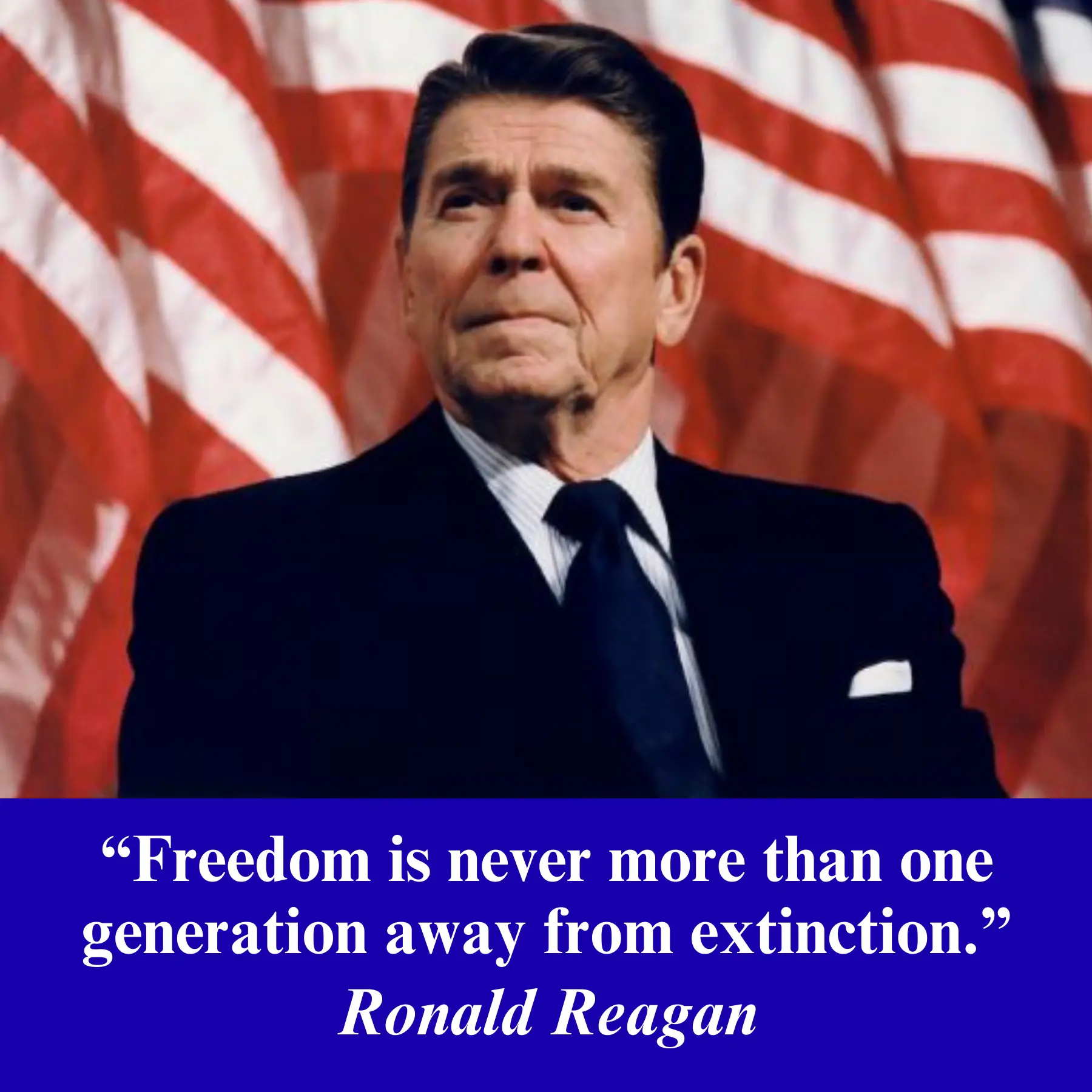
Petraeus is channeling President Ronald Reagan, who argued that “support for freedom-fighters is self-defense” and “is tied to our own security.” Were he still with us, Reagan would be leading efforts to help Ukraine defend itself from Russian aggression. His motivations would be twofold: As an idealist, Reagan believed deeply in freedom, in America’s role in advancing freedom, in America’s responsibility to stand with those willing to stand up to aggression. And so, Reagan would support Ukraine because Ukrainians are fighting for their freedom. Reagan also was a skillful practitioner of hard-nosed realpolitik. Consider his unswerving commitment to “peace through strength,” ruthless proxy war against Moscow in Afghanistan, missile deployments in Europe, intelligence operations with kinetic effects, naval engagements in the Mediterranean and Persian Gulf. And so, Reagan would support Ukraine because doing so exploits a Kremlin miscalculation, weakens Russia’s tyranny, whittles down Moscow’s military capabilities, and advances America’s interests—all at minimal cost in American treasure and no cost in American blood.
Anyone who claims Reagan’s mantle should remember that he challenged the American people to “stand by our democratic allies”—and that he pledged America would “not break faith with those who are risking their lives…to defy Soviet-supported aggression.”
Bridge-Builder
Finally, this transatlantic deal could work because Stubb is behind the idea.
Stubb, who attended Furman University in South Carolina on a golf scholarship, describes himself as “Finnish by birth, southern by the grace of God.” He was one of the first world leaders to meet with Trump after the president’s second inauguration. While golfing together in March 2025, the two presidents found common ground and laid the foundation for a close partnership. They reportedly text or talk by phone weekly. Stubb has taken on the role of “Trump Whisperer” for his European allies, and he serves as a bridge between Washington and Europe. That’s critically important given Trump’s frustration with Europe—and Europe’s bewilderment with Trump. Ukrainian President Volodymyr Zelensky, for instance, credits Stubb for “helping build a connection” with Trump.
Stubb’s next challenge is convincing Europe to deploy warships to the Strait of Hormuz, persuading Washington to deliver weapons to Ukraine and reminding both sides of the Atlantic that they need each other.